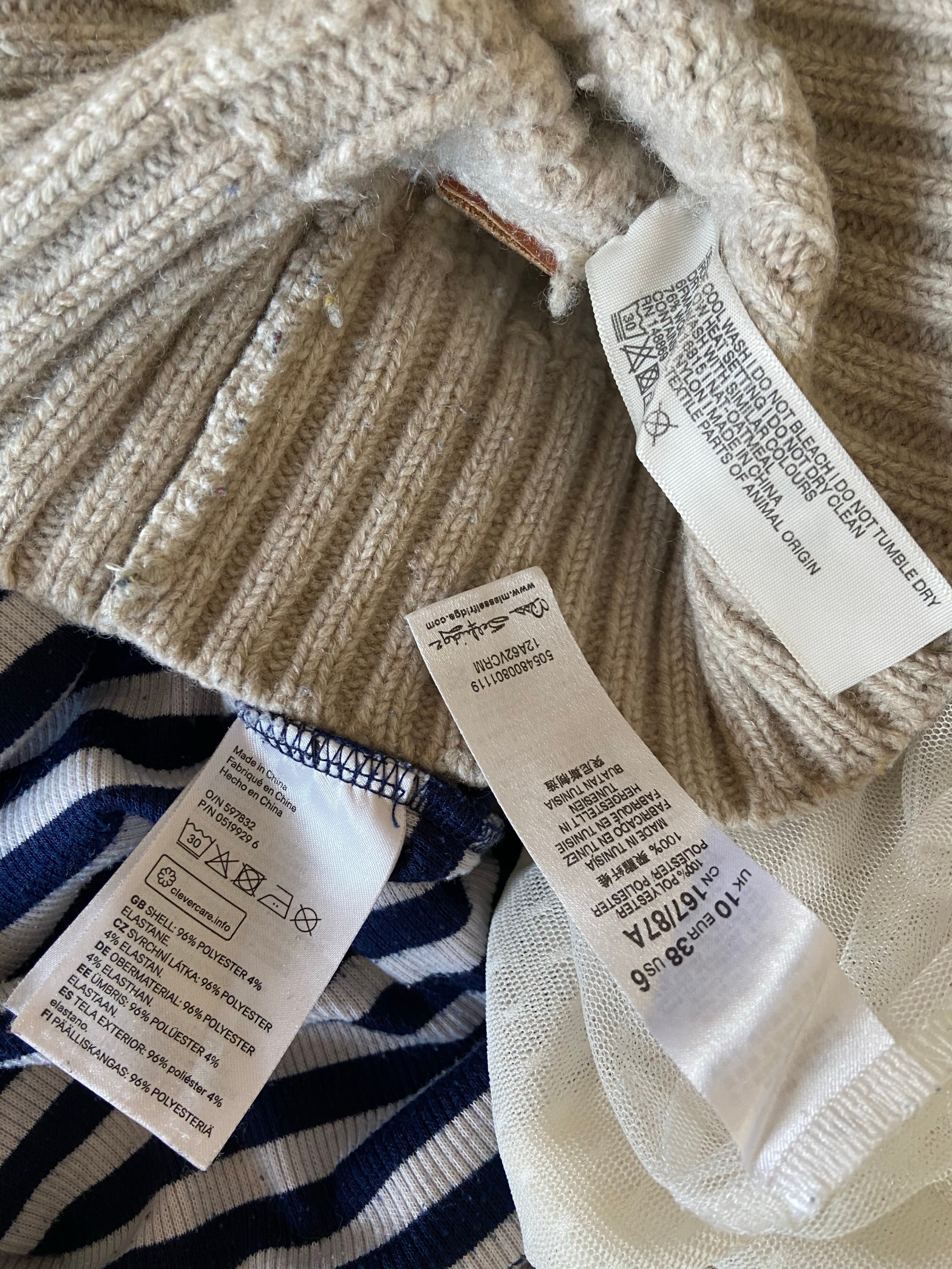
When I was younger and I’d go clothes shopping with my mum, we would always steer clear of items that say ‘hand wash only’, and try not to buy clothes made from synthetic materials. But are either of these things good? In this weeks label series post, I’ll be talking about the labels we see on clothes, which are mostly material and care labels. This will be slightly different to the food labels and packaging labels, as some of these are a guide to making your clothes last as long as possible, which is great for the environment.
Washing Symbols
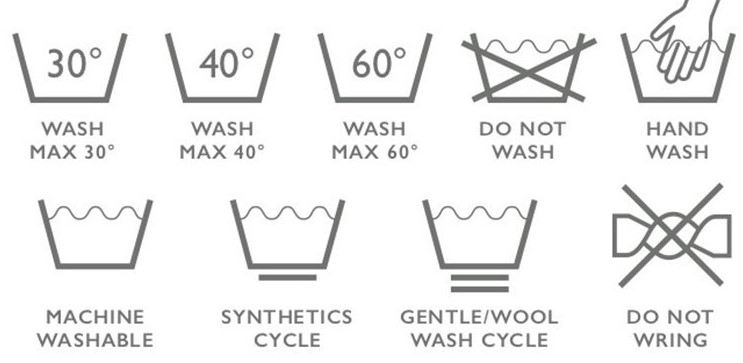
These symbols mostly all involve a bucket and instruct you as to how to wash your clothing item. In terms of sustainability, I tend to wash everything at 30 unless the item calls for a cooler temperature. I also wash delicate items (like tops with loose stitching or embellishments) inside string bags, so that they are protected from other clothing items. It’s also best to use natural ingredients in your washing powder, as this will be kinder to the oceans. Go for plant-based, organic and vegan (not tested on animals) where possible.

Drying Symbols
These symbols let you know whether or not something can go in the tumble dryer, what heat to put it on, and whether to use a delicate cycle. Obviously, using a tumble dryer is not great for the environment, as the average cycle uses 4kWh of energy and produces about 1.8kg of CO2. So, always try to dry your clothes outside if you can, or on an airer near good ventilation (to prevent condensation). Both of these methods are actually better for your clothes and help them to last longer. If you do need to use a tumble dryer, then the following things can help keep the energy usage lower:
- Put your washing on another spin cycle so that the clothes are not as wet, and therefore do not need as much time in the dryer.
- Fill up your dryer instead of doing lots of little loads.
- Separate your clothes out so that the air has lots of room to circulate, so the clothes dry quicker.
- Put similar materials together so that everything dries evenly – for example, if you put a towel in with t-shirts, the towel will dry much slower than the t-shirts, so put it in with other towels.
- Clean your filter regularly and keep the vents clear.
Ironing Symbols

Each person emits about 190 kilograms of CO2 per year from using electric irons. So avoiding it where possible is a good idea. A pro tip for those of you who either don’t want to iron, or do not have an iron – hang up your item in your bathroom when you have a shower, and leave to hang – it’s not perfect, but it does remove some wrinkles, particularly if the garment is heavy. You can also avoid ironing by being careful with how you place items out to dry – if you dry them flat, there shouldn’t be too many creases. These labels tell you whether you can or cannot iron, and at what temperature. Some materials such as silk need to be ironed at a low temperature, and others cannot be steamed such as suede. If you are ironing, try not to turn your iron on and off all the time, as the heating up of the water and restarting the iron uses the most energy.
Bleaching Symbols


Bleach is sometimes used on whites to make them brighter, but not all fabrics can be cleaned with bleach. The following symbols tell you whether an item can be cleaned using bleach. Bleach is not great for the environment, but if you want your whites to be white, then there are some alternatives. Baking soda, white vinegar and lemons are all great natural whiteners, as is the sun! You can also use oxygen-based bleach and hydrogen peroxide. All the measurements for these ingredients can be found on The Spruce in the sources section.
Dry Cleaning


There are some items which should be left to professionals, like coats and jackets or highly embroidered items like dresses. Dry cleaning can help an item to last longer, as the process is more delicate than with an everyday machine. However, the process of dry cleaning often uses harsh chemicals and produces hazardous waste, such as ‘solvent, soils, carbon, dyes, grease, and powdered filter material’ (Eco Street). A chemical called perchloroethylene is often used, which can cause fertility issues, contaminate water and create dangerous smogs. Some dry cleaners have changed chemicals since this was discovered, but it is still better to wash your own clothes where you can. These symbols tell you whether an item can be dry cleaned, and what solvent should be used.
Overall, these labels just give you the correct instructions for the item you have purchased. In order for these labels to help you to be more sustainable, we need to know what the processes include and what they do for the planet. So, always read the labels, and be considerate when you’re doing your washing and drying!
Sources:
- Ariel – https://www.ariel.co.uk/en-gb/how-to-wash/how-to-do-laundry/fabric-care-labels#step1
- Guardian – https://www.theguardian.com/environment/ethicallivingblog/2008/may/02/treadlightlyswitchofftumbl#:~:text=An%20average%20drying%2Dmachine%20cycle,of%20CO2%20in%20a%20year.
- Green Age – https://www.thegreenage.co.uk/how-bad-are-tumble-dryers/
- My Best – https://mybest-gb.uk/3749#toc-0
- Eco Street – https://www.ecostreet.com/dry-cleaners-environment/
- The Spruce – https://www.thespruce.com/green-substitutes-for-chlorine-bleach-2145990
- The Sustainable Clothing Collective – https://www.the-sustainable-fashion-collective.com/2015/07/16/environmental-impact-of-the-washing-machine
 Waste Makes Waste
Our dryer (beko air pump) uses less electricity than most. I think it works by reusing the heat from the drying process. Although it was much more expensive than a condenser dryer and it DOES take a long time, it is definitely worth looking at if you are thinking of replacing your dryer.
LikeLiked by 1 person