Featured

Little Things & Big Things

Welcome to the new series on this blog – Little Things & Big Things.

To give you an example of where I’m going with this, my first topic will be packaging – the ‘big’ thing here is the amount of packaging ending up in landfill, legislation coming in around plastic packaging and the damage that can be done by a meal deal. The ‘little’ thing I’d like to focus on is how I minimise packaging by prepping the food I take to work, so I don’t have to run out to grab lunch, and some easy recipes that help me with that.

So that’s the series! Hopefully I’ll be able to do one topic per month, alongside anything else I manage to write.

Are there any big topics you want to see? Any little topics? Share your thoughts!

Featured

Thoughts during Coronavirus

Hello friends.

First of all, I hope everyone is keeping well, staying safe and STAYING INSIDE. It’s a weird time for a lot of reasons, and one thing that I have been thinking about a lot is the environment.

I’ve been hearing a lot on the news that the environment is recovering around the world as a result of lockdown. For example, in Venice the waters are the clearest that they’ve been in 60 years, and there are (temporary) falls in the level of carbon dioxide and nitrogen oxide in several countries. The main thing that I’ve been thinking about is what happens when we all go back to normal? The planes start flying, we all start driving again, we throw things away because there aren’t any shortages so it’s ok to waste food again? I’m concerned that any positive things (which there are few of during these horrible times) to come out of this time will be lost almost immediately.

Most of the things I’ve written about in this blog have gone a little bit to the wall. It’s so much more important at the moment to get the food that we can, to focus on staying healthy (mentally and physically) and to get our world back to where it should be so that we can take a long hard look at how we dealt with this situation, and grieve for all the people who have lost their lives. However, while I have all this time on my hands, I want to think about climate change so that when we recover, I’ll be ready to bounce back. That means more blog posts!

Firstly, I want to learn more about climate change – the actual science behind it. I have a limited knowledge, and I would like to be able to explain why it all matters. I also want to talk about composting and growing food, as these are two things that I’m new to. I’ll also throw in a few DIY’s for people who have time on their hands (like me ahhhh). I’m sure there will be more topics, and I’m open to suggestions as well!

Lastly, climate change is overwhelming, and coronavirus is overwhelming, therefore it’s difficult to try and think about both. So, I think it’s ok to not be able to think about either for a little while, with the knowledge that at some point, we’ll all be able to bounce back. I sincerely hope that there will come a time when there are no crises.

Take care of yourselves ❤

Sources:

https://www.theguardian.com/world/2020/apr/09/climate-crisis-amid-coronavirus-lockdown-nature-bounces-back-but-for-how-long

https://www.classicfm.com/music-news/coronavirus/venice-canals-clear-dolphins-swim-italy-lockdown/

Featured

Hello!

Hello there! My name is Lucy. I’m a twenty-something vegetarian who is trying to do her bit for the planet. This first post is just a little bit about me and a bit about why I have started this blog!

I have always been a lover of all things animal and outdoors, and in the past year I have become really interested in anything eco-friendly. As part of this, I have tried to cut down my waste, particularly plastic waste, in an effort to do my bit for the planet. A lot of the changes I have made have made little or no impact on my life, and I want to share some of these changes to help people going through the same journey.

I am by no means an expert – I’m simply an enthusiast. I’m still figuring all of this stuff out and I am very far from being zero waste. However, I think it’s better for everyone to do a little bit rather than a few people doing everything while others continue to ignore the climate crisis.

So, I’m really excited to start writing and sharing my experience (in a post every Monday), and thank you for reading!

Lucy x

Should I be doing something about climate change?

Don’t worry, I haven’t done a 180 spin on my opinions of climate change.

In this post I want to talk about something I saw on LinkedIn a while ago, which said ‘you are not responsible for climate change’, the ‘you’ here being the everyday person. It then went on to detail the impacts of oil companies, inaction on the part of government etc. While I agree, we 100% need to hold governments and organisations to account, especially those who are ignoring the climate crisis and/or ignoring that it exists, I’m not sure that the everyday person isn’t somewhat part of the problem.

I realise that this is somewhat controversial, so let me be clear…

Some things are unavoidable. For example, we cannot help it if the public transport near us is unreliable, or we can’t use it to get to work or the shops etc. Not everyone can affort to put more insulation in their home, or have an electric vehicle, and some people might not live in homes that are suitable for energy efficiency upgrades. There are some huge equity issues in the climate crisis and the solutions to it, which are sometimes overlooked by those pushing for climate action, particularly as it has become a little more mainstream.

However, some things are (to some extent) avoidable or controlable. One example of this is diet. Most people have a say about what they eat day-to-day, and have the opportunity to choose a plant-based meal over a meat or fish based meal, for example. Another example is in purchasing of stuff, let’s think of clothes as an example. Most of us have too many clothes, lots of which we don’t wear, and yet we continue buying more from fast fashion brands. We do need clothes (obviously, don’t even think about it), but we can make conscious decisions about where we buy our clothes, how often we buy them, how we look after them, and how we dispose of them when they no longer serve us. Again, there are obvious equity issues with both of these examples such as limited sizing for larger or smaller bodies, allergies and dietary restrictions, culture and religion, finances etc., but there are lots of people to whom these types of challenges don’t apply. I’m guilty of both of these examples, so this is by no means a finger pointing exercise.

So am I saying individuals are to blame for the climate crisis? Absolutely not. However, I do think we underestimate how much power we have as individuals, especially if we work as a collective, influence each other and spread the word about what we’re doing. Ultimately, businesses and governments will follow the general consensus, so individual choices around food, clothes, transport etc. will make a difference.

What do you think? Should we be encouraging individuals to take action, or is it all on the big companies and governments?

Hello again!

Hello – extremely long time, no see!

Apologies for being gone for a pretty long time – it has been just under 10 months since I last did a blog post, and since then I’ve sporadically used my Instagram page. The main reason for this is that I have been very busy, and just keeping up with a 9-5, a small social life and general self-care has been a bit much. The other reason is that my perspective has changed slightly, which is what I want to start talking about today.

When I first started this blog, my focus was on small changes like keeping hold of jars, making dry shampoo or using up food scraps. Those things are still really important to me, but through my job and my continued research and education about climate change, I’ve realised how much system change we need. The cold, hard truth is that without that system change, the jars, dry shampoo and food scraps make a tiny dent, and don’t do much more.

Let me reiterate – I still think that all those things (everything I’ve yapped on about on this blog) are impactful and important, especially if we all share and support each other. But, there is no doubt that a lot of these things are difficult, and that it would be easier if the system was built and maintained to make these things easy. Maybe then we wouldn’t be in this mess. Additionally, there are some things that cannot be overcome by using lemon peel to clean my sink (much to my disappointment).

So what does this mean for the blog?

I guess I want to show how my mindset has changed by incorporating both angles. So that means some recipes/DIYs/things that are more climate friendly, but also some more informative posts about the science of climate change or the barriers that we have to overcome.

Hopefully I’ll be able to put some posts out over the next few weeks. In the meantime, if there is anything you would like me to write about, please let me know – I want this blog to be useful and informative, not just lots of staged pictures of me with recycling (although there will be some of that).

Until next time!

Having therapy for climate anxiety

Well, that sounds like a cheerful subject doesn’t it? Sadly, climate anxiety is becoming more and more common, particularly in young people. I’ve spoken about climate anxiety before, but having been having therapy for the past couple of months, I wanted to talk about my experience of being treated for it. To clarify, I am currently having CBT for generalised anxiety and health anxiety, which I’ve spoken about before.

One of the things I’ve learnt in therapy about worrying is that worrying is the brain trying to solve a problem. By worrying, we are thinking about possible routes to solutions and preparing ourselves for possible outcomes. For example, if we worry about how much money we have, we might think of ways to save money. Or, if we worry about a persistent cough, we might think about going to the doctors or obsess about what it could be. This is as unhelpful as it sounds, because we cannot actually solve the problem just by worrying about it.

Leading on from this, worries can mostly be split into hypothetical or current problems. Hypothetical problems are things that haven’t happened yet, or ‘what if’ problems. For example, ‘what if I get a terrible illness’. Current problems are about something that is happening. For example, ‘I don’t have enough money to pay my rent’. Therefore, if worrying doesn’t solve problems, and a lot of the worries I have are hypothetical, then worrying about them isn’t a great idea. These explanations are extremely helpful for a lot of the anxiety that I experience, like health or social related worries.

But not for climate anxiety. Climate change is neither a current nor a hypothetical problem – it’s happening, but not in a super direct way (i.e. my house hasn’t flooded), but it isn’t hypothetical because it IS happening, and it is terrifying. The usual approach to a hypothetical problem is to acknowledge it and then move on. The usual approach to a current problem is to acknowledge it and try to do something about it if you can. Both of these things are very difficult when it comes to climate change. The worry is so current, and yet so untouchable.

So, solutions to this hypothetical/current problem are difficult. We can’t (or at least I can’t) ignore it completely, so there goes option one. Option two is to find something productive to do about it, such as reducing your energy use, reducing plastic, going to a march etc. However, we know that these things, whilst important, do not have a massive impact on climate change. This is why the conventional approach for therapy doesn’t necessarily fit climate anxiety. One of the reasons for this is that ‘climate anxiety is a rational response‘ to a very real threat – one which feels as if it’s getting closer and closer. This is why the methods that work for reducing my other anxieties about my health or whether people hate me, do not work. So what will work?

  1. Having therapy – although I’ve said that a lot of the treatments for anxiety do not work (in my opinion) for eco anxiety, they can reduce general anxiety and help you to cope with any symptoms such as panic attacks, intrusive thoughts etc. Whilst this doesn’t fix the problem, it can reduce some of that doomsday thinking.
  2. Spending more time in nature – again, this might work for you, or it might not. Whilst being in nature generally reduces stress, it can also be a reminder of what we will lose as the planet starts to deteriorate. This can be motivating or it can be upsetting, but it’s still a viable option (and a great thing to do regardless).
  3. Spending less time online OR editing your follow list – following discourse about climate change is part of my job, so I find it hard to switch off from. However, if you find that reading about climate change, particularly on social media, causes your anxiety to worsen, then it’s worth thinking about what information you actually want to see. For me, this means that I follow a mixture of activism groups, journalists, zero wasters and good news accounts. This helps me to feel like I’m seeing a mixture of news including solutions, the good things that have already happened, failures of governments and people experiencing the same anxiety.
  4. Think small and big scale – regardless of what you’re worrying about, worrying about something we cannot change is not very helpful. In the same way, worrying about the whole climate crisis when you’re one person is not very helpful. That doesn’t mean it’s not important, it just means that it can be better, more productive and more satisfying to focus on what we can change. That can be small or large scale. For example, if you’re worried about your personal plastic use, you can reduce that. On a larger scale, if you’re worried about a couple of the issues in your local area, you can join groups, go on marches, write to your MP, etc. The important thing is that worrying shouldn’t make us powerless, it should motivate us whilst allowing us to enjoy what we currently have.

That was a bit of a heavy one, but I’ve been thinking about it for a while. I promise that future posts will include more cake and general happiness.

Don’t Look Up – the Parallels to the Climate Crisis

SPOILERS AHEAD

‘We really had it all didn’t we’

This is the most poignant line of Don’t Look Up to me, as Leonardo DiCaprio, Jennifer Lawrence and their families are struck by the comet. This line has stuck with me since I watched the film. What really struck me about Don’t Look Up is what seems to have struck a lot of us in the environmental space – there are some striking similarities between Don’t Look Up and our current handling of the climate crisis. So today, I wanted to talk through those parallels.

Before I get to that, what did I think of Don’t Look Up as a film? I thought it was good, but certainly not the best film I’ve ever watched. As I’ll go on to explain, I think they really captured human responses to problems and particularly how we act in a crisis, but other than my own comparisons between the plot and real world events, I thought it was a little lacking. I resonated with the scientist characters, but I thought that some of the other characters went a bit too far into spoof at times. But, I’m no film critic, I think the film had some really poignant points, and I really enjoyed it. So here are the two biggest similarities I found.

As I said, I really resonated with the scientists in this film. In particular, it was their frustration that resonated with me the most. Just as the scientists in Don’t Look Up grapple with being questioned over the certainty of the comet hitting earth, climate scientists are constantly being questioned as to how climate change will impact us. As they discuss the issue with Meryl Streep, the President of the United States, she is relieved to hear that they are not 100% certain that the comet will make impact – they’re only 99%. Sound familiar? Scientific uncertainty usually refers to imprecision but is misunderstood to mean that the results are invalid. This was particularly clear in Don’t Look Up, and is easy to see with many issues currently facing the world – not just the climate crisis, but also Covid-19. In the film, the President only agrees to do anything about the comet once her popularity is diminishing, and then she pushes that scientists are almost 100% certain of the impact. So, uncertainty only seems to be a problem when it doesn’t fit with the agenda.

Another huge parallel for me (and possibly a reason that this film has had poor reviews), is the media response to the crisis. In Don’t Look Up, the two scientists go on a morning TV show to talk about the comet after the President dismisses them with very little intention of doing anything. Whilst they have a very serious and terrifying message and the presenters do ask some valid questions, but they quickly start joking and making light of the situation. This was obviously exaggerated in the film, but the sentiment is the same – climate change often gets made to seem less scary than it actually is, probably so that the audience continues to watch. Additionally, just as with the politicians, in Don’t Look Up other news stories dominate the news, such as celebrities getting married. This is pretty similar to what is going on now – that doesn’t mean that other stories aren’t important, but when you think about all the coverage that Covid-19 gets compared to the coverage that climate change gets, there’s no comparison.

Overall, I think that this film draws some important parallels to our world today. We critique the people who have the knowledge, but allow the media to sensationalise headlines and divert our attention to what they believe is important. We fail to treat a crisis like a crisis, especially if there is another crisis that is more immediate, more important or more personal. We fail to act until the very end, even when we know what to do. Peter Bradshaw from the Guardian called the film ‘laboured, self-conscious and unrelaxed’ – I would disagree. Although at times it is a little too much like a comedy sketch, this self-consciousness is exactly what gives the film the important parallels that captivated me as a viewer. It was laboured in that I could feel the frustration of the characters, because that is the frustration that I feel constantly. And finally, the film was not relaxed – it was frantic, anxious and disjointed, but again, I think that that is part of what made it so relevant for me.

There we go, there are my thoughts on Don’t Look Up – what do you think? Do you see any parallels between the events of the film and the climate crisis? Did you enjoy it as a film? Let me know!

Did I keep my New Years Resolutions in 2021?

Happy New Year! Like most people, I’m finding it hard to be optimistic about 2022 with climate change, the pandemic and world politics. However, I do like the idea of starting a new year and making changes or trying to do more of something. Last year, I did a post detailing my resolutions for 2021 – the question is, did I follow them? So today I’m going through each resolution and seeing whether I actually kept them!

  1. Go for a run once a week

So I did (mostly) manage this! I started running in 2020 and in 2021 I started running once a week, and eventually built this up to three times a week in order to train for a 5k. I did my 5k in September, and since then I’ve gone back to running about once a week, but mostly for long runs rather than shorter ones. I’m really proud of keeping going with the running for 2 main reasons. Firstly, it’s something I thought I could never do, and yet every time I run it makes me feel like I’m capable of anything. Secondly, I love getting out into nature, particularly early in the morning when there’s no one around. So this resolution was a success!

2. Keep email inboxes tidy.

Well, I gave this one my best shot. I’d say that my email inboxes are a bit tidier than they were because I keep my important emails in designated folders and delete or unsubscribe from the others. However, I tend to forget to go through my emails so they do still build up a bit – I think I’ll say this resolution was somewhat a success?

3. Bake something once a fortnight and share with friends/family.

Again, for the most part, I think I did this! Over the past year I’ve experimented a lot more with baking and I’ve made quite a few vegan recipes too. I’ve made lots of different bakes from bread to cake to biscuits, and I’ve really enjoyed them. I’ve also been pretty good with sharing them with friends and family – my parents and boyfriend have definitely received the most but I try to spread them around. This is definitely something that I’ll continue in 2022, and I’ll definitely add to this by challenging myself with more difficult bakes. Overall, this was a success!

4. Switch to non-dairy yoghurt and butter permanently.

Pretty much a success! I only buy non-dairy yoghurt and butter now, and it has made zero difference to my life, as I thought it wouldn’t. I tend to get the flora spread that’s vegan, but I also get violife or a vegan block – it depends what I can find! In terms of yoghurt, I like Alpro a lot – I’ve recently found an Alpro Greek yoghurt which I really like, particularly as a replacement in recipes because the texture is great. Obviously because I live with other people, I’m not the only person who cooks, and my parents and boyfriend and general family all eat meat and dairy, so have I avoided dairy yoghurt and butter 100% of the time? No. But, I’d say I have about 95% of the time, which is definitely progress.

5. Investigate zero-waste make-up as I use up my current make-up.

Well, it took me a long time to get to this resolution because I don’t wear much make-up anymore. However, for Christmas I got a refillable mascara, eyeliner and lipstick which I’ve tried and absolutely love, so I’m really excited to see how I get on with them this year. This is definitely a success, but I’ll need to keep exploring to get a full zero-waste make-up kit.

So those were my resolutions of 2021, but what are my resolutions for 2022?

I only have one resolution this year, but it’s a bit vague and encompasses a lot of things. My resolution is to embrace my hobbies. So, I have quite a few hobbies, most of which are sporty or outdoorsy. I mentioned running earlier, but I also try to do yoga as much as I can, which hasn’t been very often!. A more recent hobby of mine is roller skating. I’ve only just started, so I’m extremely wobbly, and the weather hasn’t been great so I haven’t practiced much yet. I also sew, but again I haven’t made much time for this recently, so I’d like to do a bit more of it. I’m sure I’ll get some new hobbies in 2022 as well! So, I want to try and spend more time doing these things, and maybe improving at them or feeling more accomplished. Tune in next year to see whether I managed it!
Eating seasonally in Winter

It’s the last instalment of the seasonal series! At the beginning of each season, I will release a guide to eating in that season. Throughout that season, I’ll release seasonal recipes, usually a savoury, a sweet and some sort of beverage or snack. I will be sticking to fruits and vegetables, but I’ll link a few websites that I’m grabbing this information from which also detail meat and fish if that’s something you’d like to know. Eating seasonally is another approach to eating that lowers your carbon footprint because you are reducing air miles and chemicals. When something is out of season, it means that it has either travelled from abroad or it is being grown here under manufactured conditions. Obviously, it’s pretty difficult to eat seasonally all the time, but hopefully these recipes will give you an idea as to how to incorporate more seasonal food into your diets!

This week, I’m going over what food is most available in the UK in Winter. Winter in the UK is from December to February. We get very cold and very short days, but we still get a lot of stormy weather that we saw in Autumn. We also get fog, frost and occasionally snow, which we’ve already had a little of this year. It’s not a shock that a lot of the foods that are in season around this time feature heavily in festive meals, so expect lots of festive recipes this season!

Vegetables

As I’ve said, the traditional Christmas dinner is heavily influenced by what was in season because people used to cook with what they had (ahem), whereas now we just pick from anything around the world. So, brussel sprouts, potatoes, red cabbage, parsnips, cauliflower and carrots are all in season at the moment, and are through most of winter. Mushrooms and horseradish (which I honestly didn’t know was a vegetable) are also in season at the moment.

Fruits

One of my favourite fruits ever is the humble cranberry. The main reason I love them is because you can use them in sweet and savoury recipes, like chutney or jam, or nut roasts and cake. Apples are amazingly still in season (but of course, only certain varieties), and so are some varieties of pears. That’s sort of it on the fruit front – you’ll have to to wait until spring to get some more variety!

Herbs

Herbs are also a bit sparse during winter. Bay leaves can be harvested throughout the year, and sage and thyme will survive cold weather. However, even these hardy herbs should be brought in during the winter if you want to harvest from them. A lot of the herbs I’ve mentioned throughout this series will live quite happily on a warm windowsill, meaning that they can stay in season all year round!

That’s all! And it’s the end of the series! Be sure to keep an eye out for some wintery recipes between now and the end of February, and let me know if I should do this again in 2022…

Links

Cranberry and Orange Cookies Recipe

So it’s Winter, and we’ve got some seasonal recipes for you! Cranberries are one of my favourite fruits, and luckily for me, they’re in season right now. You can pick them up at your local supermarket most of the time, but they’re also easy to find at farm shops and local markets – if you buy them this way, you might be able to buy them zero waste… They’re super versatile, and are often used as an accompaniment to savoury dishes. But today I thought I’d give you a sweet recipe to try out. As usual, this recipe is vegan friendly. Now, I use dark chocolate in this recipe, but you can use whatever chocolate you like, I just find that dark chocolate balances out the sweetness of the cranberries. So, why not have a go at this festive, seasonal recipe?

Ingredients:

  • 1/2 cup dried cranberries (you can dry them yourself or buy already dried ones)
  • 1/2 cup vegan dark chocolate chips or chocolate chunks (with some extra to put in the centre)
  • 3 cups of oats
  • 1 cup of plain flour
  • 1/2 cup non-dairy milk
  • 1 tsp vanilla extract
  • 1 cup of sugar (ensure it’s vegan if you want this recipe to be vegan!)
  • 3/4 cup vegan butter (room temperature)
  • 1/2 tsp baking powder

Method:

  1. Pre-heat your oven to 180C and line two baking trays with baking parchment (recycled or reusable if you can!)
  2. Cream together your butter and sugar until it is creamy.
  3. Add your vanilla essence and your milk and mix to combine.
  4. Then add your flour, oats and baking powder and stir until there are no lumps of flour – be careful not to overmix.
  5. Next, add your chocolate chunks and cranberries and mix in, making sure they are well distributed.
  6. Shape the dough into balls, and place a chunk of chocolate inside each ball. Place each ball onto the tray, ensuring they are spaced out well.
  7. Bake for about 15 minutes, or until golden brown and cooked in the centre.
  8. Enjoy!

I hope you enjoyed this seasonal recipe – why not have a go at this once you’ve run out of Christmas food, or make them as a gift for someone?

My New Phone Case

So my old phone case was beginning to fall apart. This was entirely my own fault – I picked it apart at the corners until bits started falling off as a nervous tick. So after months of thinking about it and feeling guilty about making any sort of purchase, I finally bought another one and I love it, mostly because it’s relatively sustainable. Is it perfect? No. So today I thought I’d take you through my choice, and see what you think.

Alongside the new phones that come out, new cases come out too. If a phone changes size (think the iPhone13 compared to the iPhone6) or shape (the new double screened phones), then you’re encouraged to get a case to protect it from the elements. This means that we buy phone cases pretty often – let’s say you have a phone from age 16 to age 70, that means you get through, on average, 27 phones. Even if you manage to reuse a couple of cases, which you probably won’t, that is still a lot of cases, and it’s not just you. In fact, more than 1 billion phone cases are produced every single year.

So what factors did I want to take into account when buying a phone case? First of all, what is the case made of? We know that plastic takes a long time to break down, so I wanted to avoid that. Other materials like leather I dislike from a look point of view, but also from an animal rights point of view. Fake leather is also not what I want, and takes a very long time to biodegrade. Silicone also takes a long time to decompose, mostly because it is a very durable material. So, ideally I want a phone case that has been made with a material that breaks down easily and potentially that has already been recycled.

Then, we’ve got what happens to the case once I can’t use it anymore. So, most phone cases seem to go to landfill – I can’t find any statistics on this but when I look for recycling options there aren’t many that are really easy, and phone cases are often made of mixed materials, so I would assume that a lot of people just ditch the phone case straight into landfill. There are recycling schemes out there though. For example CASETiFY and Terracycle have phone case recycling methods, as do many of the brands that sell sustainable phone cases. So, I wanted my phone case to be part of one of these recycling options.

Finally, the look. This should probably be higher up the list, but I wanted to prioritise the materials and recycling options of the case before looking at the styles I like. My only real criteria was that I wanted something that screams ‘environmentalist’ because that way I might not need to say it all the time… I also wanted a phone case that didn’t clash with the colour of my phone, which is purple. Other than that, I didn’t really have many requirements.

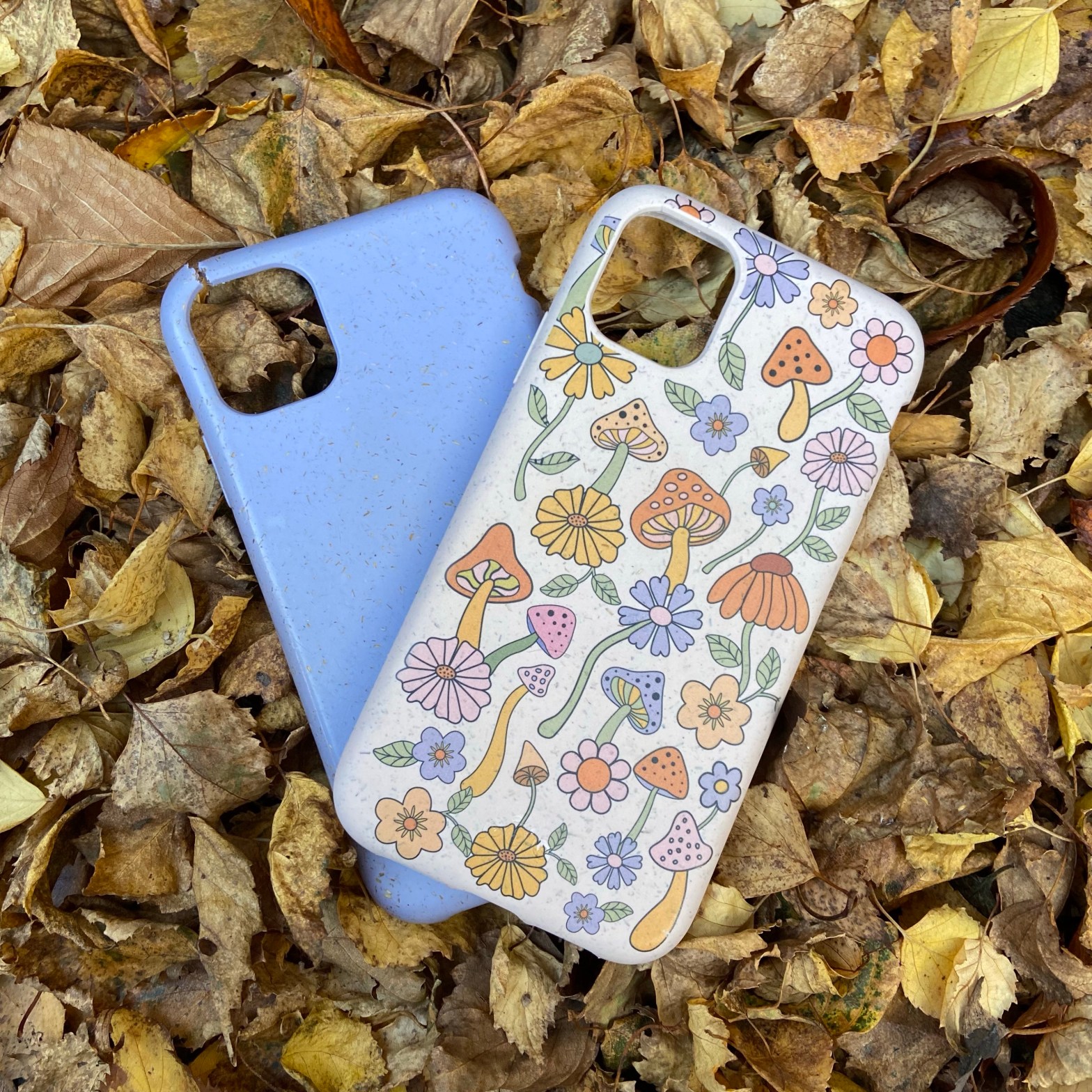
So what did I finally settle on? Well, I bought a Pela case that is decorated by mushrooms. I chose this one because a) I loved the design, b) their cases are compostable and c) they offer a recycling scheme. Now, this isn’t absolutely perfect. Pela are a Canadian company, and their recycling scheme (Pela360) only runs in Canada, so as a UK customer, I have to send my case back to Canada when I am no longer using it. Obviously, this has it’s own carbon footprint which is not ideal, however they are expanding to more countries as we speak, so hopefully this scheme will become more accessible quickly. But, overall, I’m pretty happy with this purchase because I think it’s one of the only sustainable options that I genuinely like and that will protect my phone.

So, my previous case (the purple one) was also a Pela case, so I am in the process of returning it to Pela so that they can recycle it. Let me know what you think – are there other brands of phone case that you like? Do you think there is anything else to consider when we buy phone cases? Let me know!

Why do we want to plant trees?

You may have noticed when flicking through people’s stories on Instagram that everyone has been sharing photos of their pets with a sticker saying ‘we’ll plant 1 tree for every pet picture’. So where did this trend come from and what is it about? And, what about the wider trend of planting trees as a solution to climate change? Today I’m going to be talking about this recent example of tree planting and the wider use of tree planting as a carbon sequestration method, as well as the pros and cons of this.

So, what happened with this pet planting trend? An account called plantatreeco originally posted the sticker as a campaign to show off people’s pets and to plant trees. After 10 minutes, they realised that they didn’t have the resources to cope with that many trees, so they deleted the campaign. However, a week after their initial post, the responses were still skyrocketing, and plantatreeco no longer had credit for the post due to an Instagram bug. They have now started a fundraiser that will raise money towards an organisation called treesforthefuture who are dedicated to planting trees. Sounds harmless and very positive right? WRONG. It’s actually even less straightforward than that. Plantatreeco have pulled this kind of stunt before. According to their website they have planted 6500 trees , despite the fact that they have done other campaigns like this. There is also no detail about where these trees are, whether they’re native or not, how they have been planted, etc. So, this is an example of where a trend may not actually be very charitable at all.

There’s something else that bothers me about this too, apart from the blatant lying. Tree planting has become a popular thing that companies use to tell people that they’re trying to do better for the climate. It is often used as a form of offsetting, where companies say that they plant a tree for each item sold, or the equivalent amount of carbon for shipping, or they just plant a certain number of trees over a year. Again, sounds overwhelmingly positive, right? Wrong again! Although tree planting is definitely important, because trees sequester carbon dioxide, it is definitely more complicated than that.

So first of all, why are trees great? Well they’re pretty to look at, but they also support wildlife, stop erosion and sequester carbon. It is estimated that we have room for an extra 0.9 billion hectares of forest on the planet, which could store 752 billion tonnes of carbon once they are mature – it’s worth noting here that this estimate has its issues with accuracy, but you get the point. As a result of this kind of evidence, tree planting schemes have sprung up everywhere and are one of the most mentioned methods of removing carbon from the air.

So what’s bad about this? Trees do sequester carbon, yes, but tree planting causes greater soil respiration and lowers levels of carbon in soil, which cancels out the increase in the trees biomass carbon over time. This basically diminishes the carbon sequestration of trees. This isn’t necessarily a huge problem, it just means that we need to understand how trees store carbon and the whole process better before we roll out mass tree planting schemes. Additionally, tree planting schemes often just plant 1 type of tree in rows, which really diminishes biodiversity, one of the best features of forests. Growing trees requires water, so if trees are planted somewhere where water is scarce, this may put pressure on already depleted resources. For example, China has increased its forest coverage rate with black locust trees, but a recent study has found that water availability and the water cycle itself have been altered.

So, there are two main takeaways from this. Firstly, if you want to donate to the environment, make sure that the place you’re donating to is a legitimate organisation that is actually going to fulfil their promises. Secondly, be critical of tree planting, but still support it when it has actually been thought through. That’s all from me today – let me know what you thought down in the comments!

Design a site like this with WordPress.com
Get started