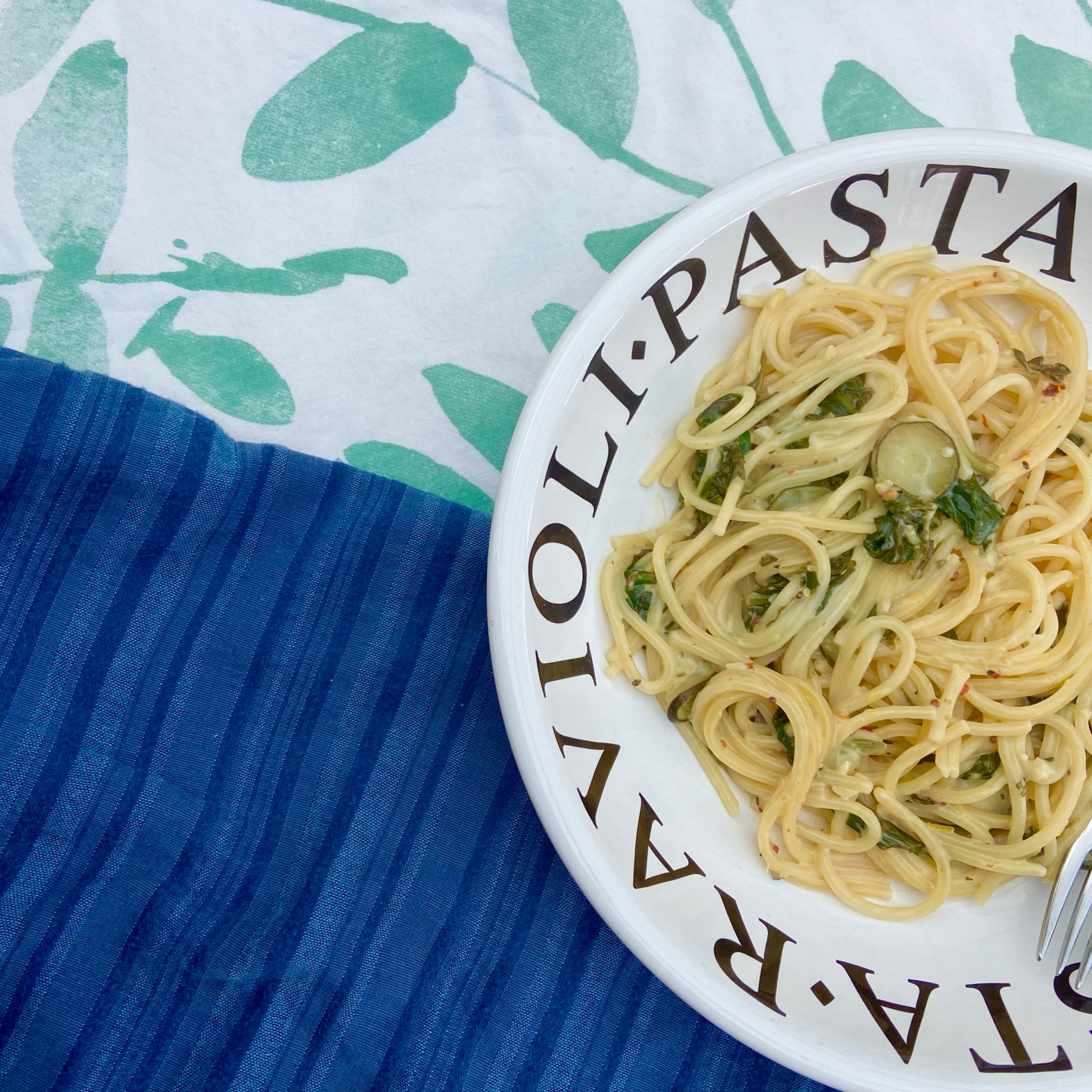
Courgette and spinach pasta

Hello! Long time no see. It’s still (somehow) summer, even though it doesn’t feel like it. So, how about a final summer recipe? This uses spinach and courgette, which are both in season in summer. This recipe serves two, but if you want more or less, have more or less! Enjoy!

Ingredients:

  • 4 handfuls of spinach
  • 1 medium courgette
  • 1 lemon (juice and zest)
  • 2 cloves of garlic
  • 1 cup of cream/creme fresh (I used soy)
  • Salt, pepper and chilli flakes to taste
  • 1 tbs olive oil
  • 160-200g pasta (I used spaghetti)

Method:

  1. Put your water on to boil and add your pasta.
  2. Chop up your courgette into disks and crush your garlic. Zest and juice your lemon.
  3. Add your oil to the pan to heat up. Then add your courgette, garlic, spinach and lemon zest.
  4. Cook until the spinach is wilted and the courgette is browned.
  5. Add your lemon juice, cream, salt, pepper and chilli flakes. After 2 minutes, add a spoonful of water.
  6. Once your pasta is cooked, add it to your sauce.
  7. That’s it! Stir, serve up and enjoy.

That’s it for now! I’ll be back soon with some great posts, but for now I’m just ploughing through my dissertation. As always, let me know if you make this recipe!

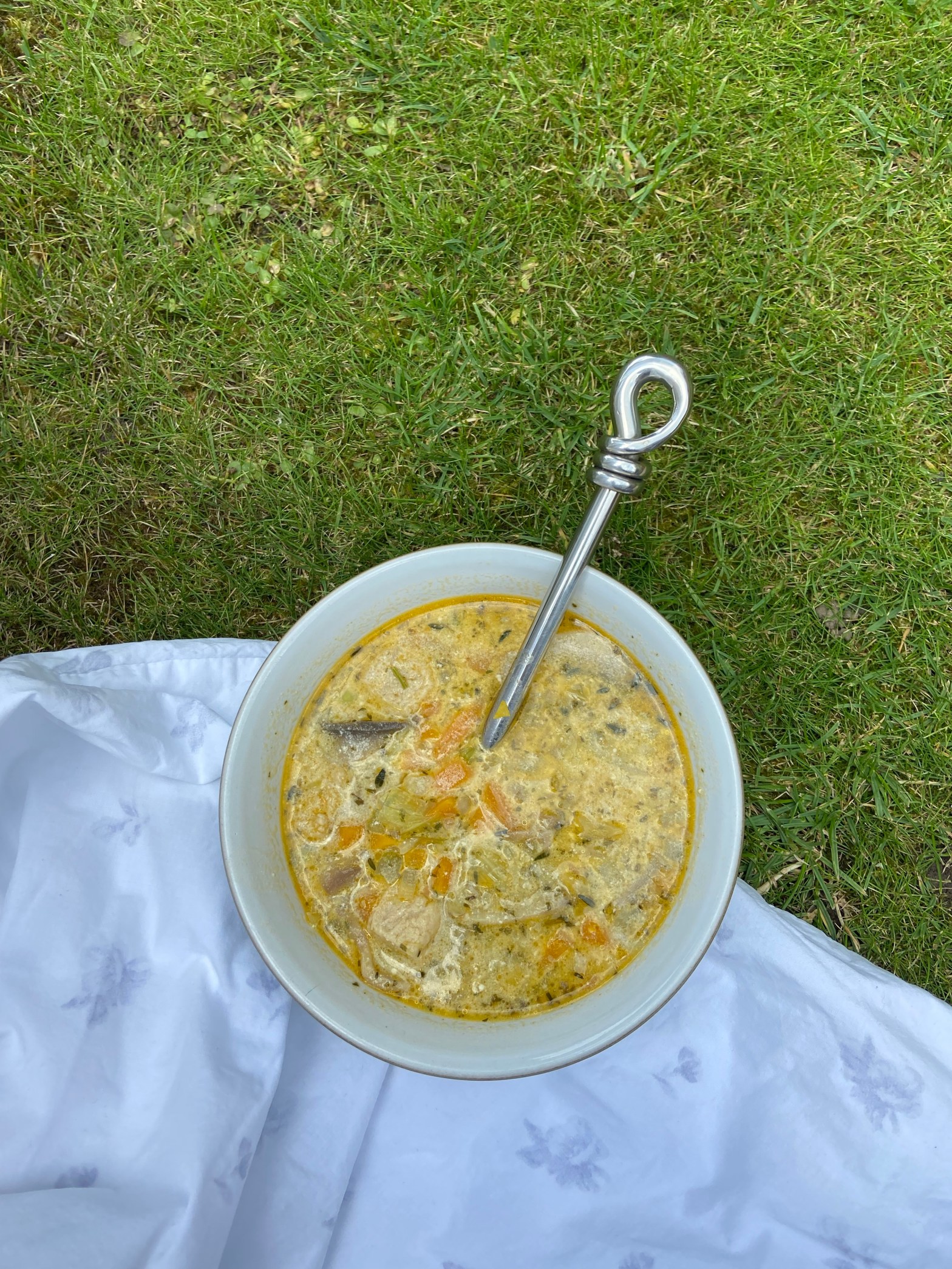
Vegan Chicken Soup

Another recipe? Soup in August? Well, sadly I’ve come down with a cold (don’t worry, it’s not covid), and I’ve been really craving chicken soup. It’s just a staple when you’re ill isn’t it? It’s warm and really satiating. So, I decided to recreate it using all vegan ingredients. It’s easy to make and not too time consuming – I made this whilst feeling sorry for myself with the cold, so it can’t be too tricky! Enjoy.

Ingredients:

  • 1 white onion
  • 1 carrot
  • 1/4 cup of cabbage
  • 1 clove garlic
  • 1 cup celery
  • 7 closed cup mushrooms
  • ‘Chicken’ pieces
  • 1 vegetable stock cube
  • 3 tbsp dairy free yoghurt OR cream
  • 5 sprigs of thyme
  • 1 tbsp paprika
  • 2 tbsp nutritional yeast
  • 2 bay leaves
  • 1 tsp dried parsley OR a handful of fresh parsley
  • 1/2 tsp dried basil
  • 1/2 tsp dried rosemary
  • 2 tbsp oil
  • Salt and Pepper

Method:

  1. First, chop up all your vegetables. Your onion, carrot, cabbage, garlic and celery should be finely chopped. For your mushrooms, chop the caps into long strips. Take the stalks and pull them apart with your hands.
  2. Heat up your oil in a large pan. Once it’s hot, add all your vegetables.
  3. Cook the vegetables for 5 minutes, then add your thyme, paprika, nutritional yeast, bay leaves, parsley, basil and rosemary. Cook for 5 more minutes.
  4. Add your yoghurt and stir for 1 minute.
  5. Add your stock with 1 litre of water. If you’re using ‘chicken’ style pieces, add them here. Bring the soup to the boil then simmer for 10-15 minutes.
  6. Taste your soup and add your salt and pepper, as well as any extra seasoning you want!
  7. Simmer for 2 more minute, then serve!

I hope that if any of you are feeling a little under the weather, this soup helps you out, and if not, you can save it for the next time you get a cold! Enjoy.

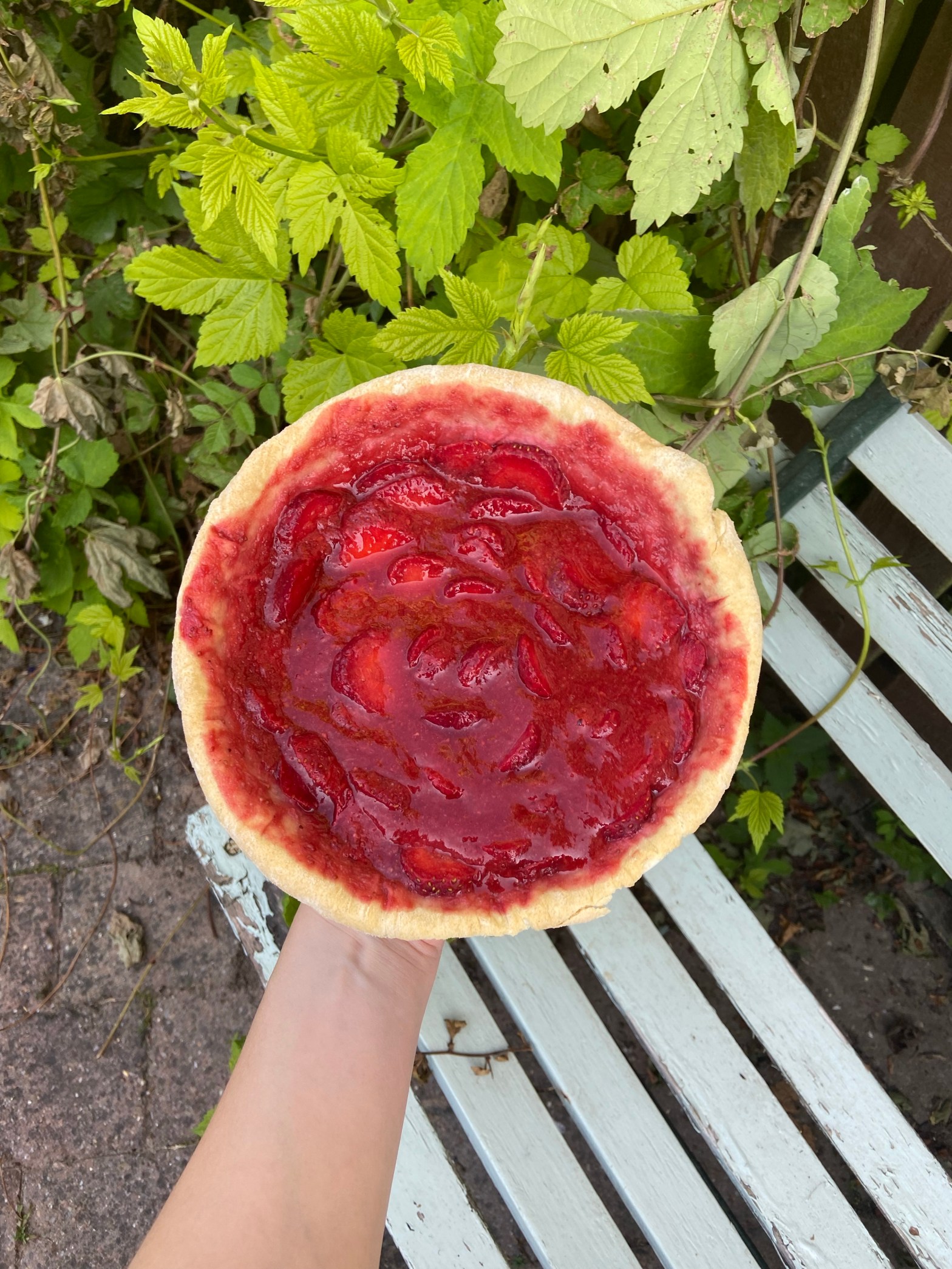
Strawberry Tart

Strawberries are the fruit of summer for me – anyone else? They’re pretty easy to find over summer, you can even go and pick them yourself. My mum has always grown them, so we’re really lucky to have loads on demand. That also means that I’ve gotten pretty good at figuring out what to do with them! Patisserie is a bit of an obsession of mine, so I decided to try making a version of a strawberry tart. Traditionally, these are made with crème pâtissière, which I have left out for this recipe, but you can always add it in or just serve it with ice cream, custard or cream.

Ingredients:

  • 600g of strawberries (300g for the coulis, 300g for decoration)
  • 50g of sugar (if you’re making this vegan, make sure that the sugar is vegan)
  • 1tsp lemon juice
  • 200g plain flour
  • 100g vegan butter (or butter)
  • Pinch of salt
  • 4-5 tbsp water

Equipment:

  • Tart case (I’d recommend going for a larger, shallower tart case)
  • Rolling pin
  • Baking beans or lentils or rice

Method:

  1. Set your oven to 180°C.
  2. Next, make your pastry. Combine your flour and salt, and then add your butter and rub together until you get a mixture that resembles bread crumbs.
  3. Add your water a tbsp at a time until the mixture comes together as a ball of dough.
  4. Cover the dough and chill while you make the coulis, or about 15-30 minutes.
  5. Wash 300g of your strawberries and remove the stalks. Add to a blender (or use a hand blender) with the sugar and lemon juice until you have a fine mixture.
  6. Pour the coulis into a small saucepan over a low heat and cook for about 15 minutes until it has thickened. Set aside to cool.
  7. Roll out your pastry large enough to cover your dish. Leave a little bit of an overhang on the edge to allow your pastry to shrink.
  8. Prick the base with a fork, then line the pastry case with baking parchment. Fill will baking beans (dry lentils also work).
  9. Bake for 15 minutes, then remove the parchment and bake for another 5-10 or until golden brown. Set aside to cool.
  10. Spread about 90% of the coulis over the pastry case and arrange the strawberries as you like. Use a pastry brush to brush the strawberries with the rest of the coulis.
  11. Enjoy!

Once you’ve made the tart, store it in the fridge. It should last for a couple of days if you chill it. I serve it with ice cream or just on its own. Enjoy!

How About…Offsetting?

Ah yes, a word we’re all growing more familiar with. Offsetting has become a bit of a buzzword when it comes to sustainability, with more and more people, organisations and governments using it as a tactic for reaching net zero. Sounds great right? Well, this week I’ll be discussing the two sides of offsetting to help you make up your mind.

So, what is offsetting? Offsetting, specifically carbon offsetting, is a method of balancing out the carbon that we’ve used. For example, someone might using offsetting if they’ve taken a long haul flight, or a company might aim to offset all of their activities. This ‘neutralises’ the carbon, so effectively you’ve made up for the carbon that you used. One of the most well known methods of offsetting is planting trees, but there are also clean air technologies or emissions trading schemes. Those are the basics, but of course it’s a lot more complicated than that.

So first of all, the positives.

First of all, it gives companies and people a chance to somewhat make up for emissions, particularly where their emissions are as low as they can get. For example, where a small company has reduced their footprint already, or a company uses heavy machinery which is difficult or impossible to reduce the carbon for, offsetting may give them the opportunity to make a difference.

Secondly, initiatives like planting trees, or working on carbon capture technology, are excellent when done right. Although there are many negatives (as I’ll discuss in a minute), the concept of offsetting may help a company or person to become more aware of their carbon footprint and what this represents. For example, we’re always given a football field as a measurement, but if you know exactly how many trees are planted every time you drive your car, it may make you change behaviours, alter resource use and generally up your awareness.

So what are the negatives?

One of the big negatives is specific to planting trees. When tree planting schemes are done, they tend to plant the same tree again and again. This reduces the biodiversity of the area, which can seriously affect the wildlife that live there. Another problem with trees as a carbon offsetting technique is that there are other types of habitat that are excellent for carbon sequestration, such as peat bogs, yet these are never mentioned. Trees also take time to start sequestering carbon – a newly planted tree is nowhere near as valuable as a tree that has been around for years. Don’t get me wrong, trees are great and they are good at sequestering carbon, but teaching people that trees are the only answer is detrimental to other important habitats.

Another lesser known negative of offsetting is its colonial links. Most offsetting strategies need a lot of land, which leads to land grabbing, with communities (often indigenous) being separated from their homes. Offsetting is yet another case of climate colonialism, which is terrible, especially when you think about the imbalance of carbon use between the countries that pollute, and the countries where offsetting strategies occur.

Another massive negative for me, and my main problem with offsetting, is the attitude. The idea that we can live how we want to and simply balance it all out afterwards, is extremely damaging. We can see this in the approach to meeting net zero – a lot of planning involves carbon capture technology which will magically take the carbon out of the air. Yes, some of the damage we have done to the planet will have to use technologies like this, and they’re innovative, but at it’s core the only way that we can do better is to reduce in the first place, and the idea of offsetting goes against this.

So there are the two sides. What do I think? Well, I think it’s a nice idea. My overall opinion is that it’s better to reduce what you use in the first place, because although offsetting is a good idea, we can never truly replace the carbon that we take out of the ground. The highly used method of offsetting at the moment, which is planting trees, also has it’s own problems that bother me, mostly the damage that it can do to biodiversity. However, I think that if (for some unknown reason), I absolutely had to fly somewhere, I would use an offsetting scheme, because this is better than flying and doing nothing. I would also be careful to look at the type of offsetting scheme, and consider those that factor in biodiversity and social benefits.

So, what are your opinions on offsetting?
Cucumber and Mint Drink

Hello! This week, I have a simple drink recipe for you. It’s really refreshing and the majority of the ingredients are around this time of year. Mint and cucumbers can both be harvested in summer. You can also make this drink as a gin and tonic if you like. Hopefully, you’ll have some lovely warm weather to pair this drink with!

Ingredients:

  • A couple of sprigs of mint
  • 5 Cucumber slices
  • Half a lime
  • Water or Tonic or lemonade
  • Ice
  • 2 shots of plain gin (optional)

Non-Alcoholic Method:

  1. First of all, remove the leaves from your mint sprigs and wash them. Slice your cucumber.
  2. Add ice to a jug and fill with water.
  3. Add the juice from your lime, your cucumber and your mint to the water.
  4. Refrigerate for at least 15 minutes to let the flavours enthuse into the water.
  5. Serve over more ice!

Alcoholic Method:

  1. Slice up your cucumber and add your slices, your mint and the juice from your lime half to a cocktail shaker. If you don’t have a cocktail shaker, just use a tall glass.
  2. Then, use a muddler (a long stick used for making cocktails) or a spoon, or a pestle to crush the mint and cucumber.
  3. Add your gin and your ice, and shake your cocktail shaker. If you do not have a shaker, just stir the mixture until it has broken up a bit.
  4. Add a new slice of cucumber to a glass along with fresh ice and strain your gin mixture (either through a cocktail shaker or a sieve) into the glass.
  5. Add your tonic (or lemonade, if you prefer).

My New Job

So, I haven’t been posting as regularly as I normally do (sorry) because I have a new job! I thought that I’d use this opportunity to explain my new job to you and let you know what I’m getting up to.

Who am I working for?

I’m doing an internship with a company called Project: WILD C.I.C., who focus on ‘merging ecological conservation, youth education and mental health support’. There’s loads of content including Activity Packs, videos, learning resources, events and live sessions. They have some paid positions, but also loads of volunteers who make everything tick over.

What do I do?

My role is a Business Development Assistant. I have a lot of different jobs which change depending on when they’re needed. So, at the moment I’m helping out with the social media (which you should follow). I’m also doing some charity grants so that Project: WILD can keep doing the amazing work it does. There’s also a new Activity Pack coming out really soon (have a look at that too) so I’m helping to finalise that. Finally, I’m looking at some broader sustainability stuff for the company and potentially for others.

Why this job?

As I’ve said many times, I want to change the world. To do that, I not only need to have a career that facilitates this, but I also need to have a greater understanding of what all the issues in the world are! I saw this internship advertised and I knew that it was the right type of thing.

Are you enjoying it?

I love it! The people are great, the job is great and the company is great. I’m really excited to see what happens with the things I’m working on.

That’s it for this week! I hope that this gave you an idea of what I’m getting up to. I will try my best to get on top of everything so that I can keep posting on here too. Thanks for reading!

DIY Air freshener

Have you ever wondered whether you can make your own air freshener? Well the answer is, yes you can. Air fresheners are one source of plastic that we often ignore – if you only buy a few a year it won’t make much difference will it? Well unfortunately it is part of the 8 million tonnes of plastic that escapes into the ocean every year. If enough people swapped to making their own and reusing an old bottle, then that could actually have a big impact. Commercial air fresheners can also contain hazardous chemicals, even if they are marketed as unscented or natural. So, at least when you make your own you have more of an idea what’s in it! The last plus is that if you make your own then you can decide on your own scents and the strength of the scents. If you want to give it a go, use the recipe below!

Ingredients:

  • Water (3/4 cup for a small amount)
  • 2 tablespoons Rubbing Alcohol OR vodka OR vanilla extract
  • Essential oils of choice (do a few drops and then see if it’s strong enough for you)
  • A spray bottle – why not use a plastic one you have left over?

Method:

  1. Add your water to your bottle. If you want to scale up the recipe, make sure you scale up each ingredient.
  2. Then add 2 tablespoons of your rubbing alcohol, vodka or vanilla extract. This is what allows the air freshener to dry after you’ve sprayed it.
  3. Then add your essential oils. If you’re using one oil, try about 10 drops and see what you think. If you’re using more than one, divide the 10 drops between them and add more accordingly.
  4. All done! Make sure to shake the bottle before use.

Scent combinations

Here are a few combinations of scents that work really well. What I will say is that if you use vanilla extract as your alcohol, this scent comes through, so you may not need to add too many more scents.

  • Lavender and chamomile (calming)
  • Ginger, cinnamon and orange (festive)
  • Lemon and orange (citrus)
  • Pine and cedarwood (outdoors)
  • Rose (floral)
  • Grapefruit (fruity)

That’s all from me! As always, let me know if you give this a try or if you have any questions.

How About… Chocolate?

I think we can all agree that chocolate is a pretty universally loved food. It’s central to a lot of celebrations and events too – Valentine’s day, birthdays, Christmas, weddings, Easter etc. But is it sustainable? Short (and sad) answer – no. Chocolate is made from cocoa, which comes from a cocoa bean which is fermented, dried, cleaned, roasted and ground. The main reason that cocoa is problematic is that it drives deforestation in some parts of the world, which is detrimental for the planet and everyone on it. So, this week I thought I’d discuss everything that isn’t sustainable about cocoa and what we can do about it.

First of all, let’s talk about the human rights. In the UK the chocolate industry is worth about £4 billion, yet many farmers live on just $1.50 per day which puts them below the poverty line. This is also less than the average price of a chocolate bar. Female cocoa farmers are disproportionately affected by this as they generally have fewer rights than men, have a larger share of chores and child care and are less likely to own land.

The main environmental impacts come from deforestation. Cocoa can grow under forest cover, but more recently hybrid plants are being grown in full sunlight, which requires forest clearing. Clearing of forests is happening at an alarming rate because of commodities like palm oil, coffee and cocoa. For example, 80% of forests on the ivory coast have disappeared, mostly through illegal deforestation. This is detrimental for the climate crisis because trees absorb carbon and will likely play a key part in future climate mitigation. Deforestation also impacts animals that live in these forests. There are many famous photos of orangutans clinging to trees whilst their surroundings are being bulldozed down. As we remove forests, we also remove the creatures that rely on them, which reduces the biodiversity of the planet.

People also rely on these forested areas – 250 million people to be exact. Firewood, food and medicine are all accessed from forests, and some are used worldwide. For example, cortisone (used in birth control), quinine (used to treat Malaria) and tubocurarine (used to treat MS and Parkinson’s Disease) are all found in forests. They also regulate water, air and soil, as well as reduce the risk of landslides and flooding. An aspect that we often forget about forests when discussing their importance is their recreational and spiritual value. All of these important benefits and services are lost when forests are removed to make way for crops like cocoa.

So does this mean you can never eat chocolate? No, it doesn’t. Like most things I discuss on this blog, there is no perfect answer, but there are things we can do. There are important things to look for on packaging when deciding whether the chocolate you’re buying is sustainable. The Rainforest Alliance Certified seal is a good indicator that the chocolate you’re buying isn’t supporting deforestation. The Fairtrade symbol is a good indicator that a product is ethical. This ensures that farmers receive fair wages and that there is investment in local communities. So, if you look for both of these labels then that should be a good way to find a more sustainable bar of chocolate.

I hope that this was helpful! As always let me know if you have any questions and whether you want to hear any more about cocoa, or whether there are other foods you want to learn about!

Eating Seasonally in Summer

It’s the next instalment of the seasonal series! At the beginning of each season, I will release a guide to eating in that season. Throughout that season, I’ll release seasonal recipes, usually a savoury, a sweet and some sort of beverage or snack. I will be sticking to fruits and vegetables, but I’ll link a few websites that I’m grabbing this information from which also detail meat and fish if that’s something you’d like to know. Eating seasonally is another approach to eating that lowers your carbon footprint because you are reducing air miles and chemicals. When something is out of season, it means that it has either travelled from abroad or it is being grown here under manufactured conditions. Obviously, it’s pretty difficult to eat seasonally all the time, but hopefully these recipes will give you an idea as to how to incorporate more seasonal food into your diets!

This week, I’m going over what food is most available in the UK in Summer. Summer in the UK is from June to August. We get long, sunny days, often some rain and very often some thunderstorms. But, there is a lot of food available at this time of year.

Vegetables

As you might expect, salad leaves are easy to find around this time of year. Lettuce, rocket, spinach and cress are all in season through summer. Although potatoes are generally associated with colder months, Jersey Royal Potatoes are harvested near the end of spring and beginning of summer. They’re great crisped up with a roast, or as a potato salad. Other vegetables such as courgettes, cucumber, radishes and tomatoes are also all in season.

Fruit

When I think of foods to eat in summer, the first fruit I think of is strawberries. Strawberries are in season in the UK from late May to early September – there are even lots of places where you can pick them yourself. Blueberries, raspberries and blackcurrants are all also available this time of year. So, there are lots of options for summer tarts and fruit salads.

Herbs

Sage grows all year round but it has the best flavour in summer. Summer is also a great time to harvest mint, which is nice in cold drinks. Chives, dill and thyme are also around during summer, and they’re easy to grow yourself. Herbs are a great food to grow if you’re unsure about gardening, or if you have very little space, or none at all. They also work well with some of the other foods listed above, for example strawberry and mint or potatoes and thyme.

Hopefully this was helpful! Keep a look out for lots of seasonal recipes this season before we move into the next one – autumn.

Seasonal Eating Sources:

Eat the Seasons

Love British Food

Vegetarian Society

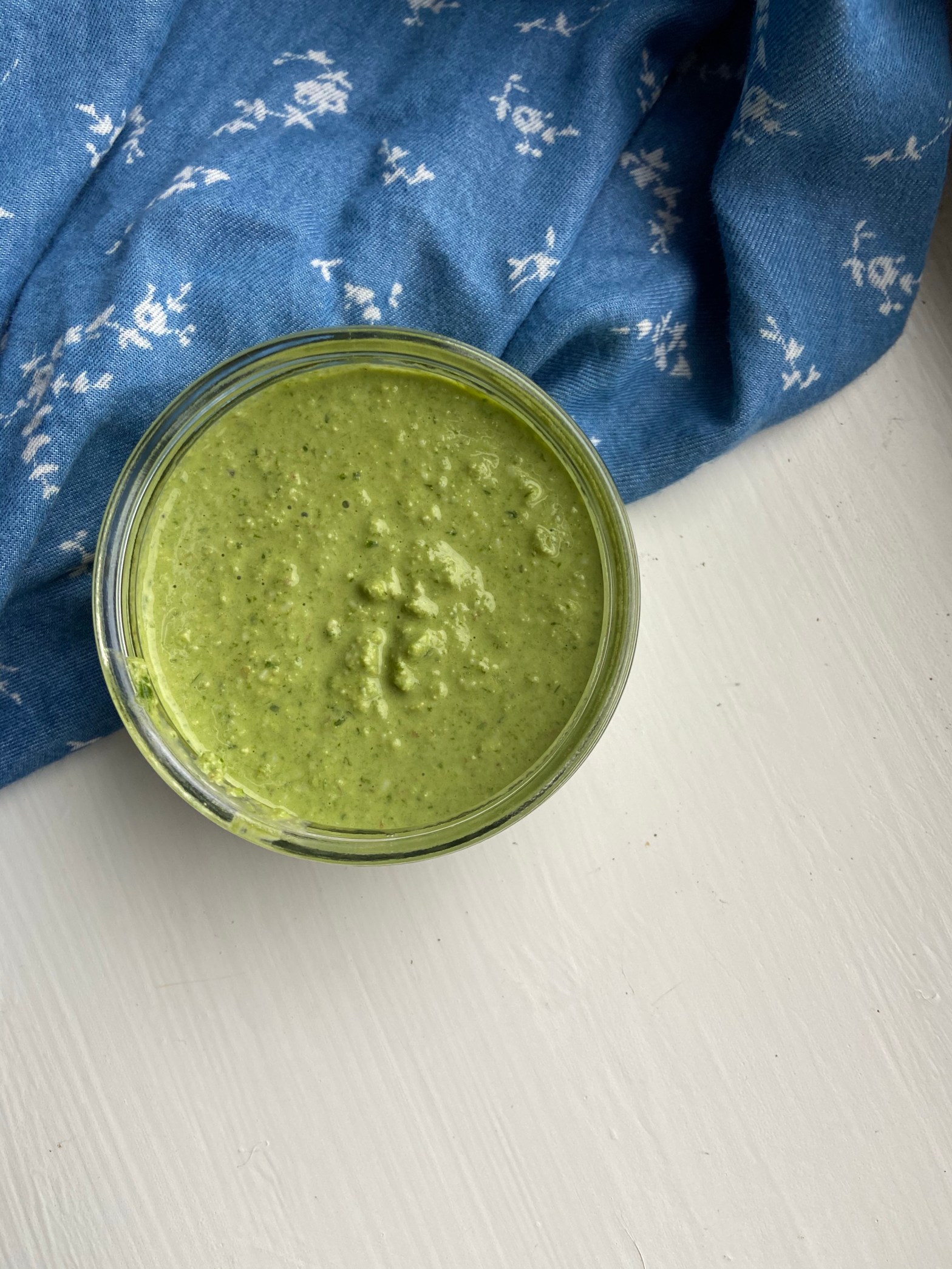
Seasonal Pesto

It’s time for another seasonal recipe! This time, it’s homemade pesto. I love pesto, I could eat it every day (and I pretty much did when I was at uni). Fresh pesto is really tasty, particularly when it’s getting warmer outside! I like to use this pesto for hot pasta dishes, pasta salads and to spread on toast or have in sandwiches or on pizza. Give it a go!

Ingredients:

  • 1 cup of Basil
  • 2 cloves Garlic
  • 3 tbsp Olive Oil
  • 3 tbsp Walnuts/Pine nuts
  • 2 tbsp Lemon juice
  • 3 tbsp Parmesan/Nutritional yeast
  • 2-3 cups of Greens – peas, spinach, kale and broccoli all work for this recipe and are currently in season!

Method:

  1. If you’re using greens that need cooking like peas and broccoli, cook them before you prep anything else.
  2. Grab a food processor, blender or pestle and mortar (if you have loads of time) and put in your garlic, lemon juice, olive oil, nuts and basil.
  3. Blend until chunky, but combined and starting to become smooth.
  4. Next, add your greens!
  5. Blend until smooth – if it is still too chunky, then add a little bit more oil or a little bit of water.
  6. Once smooth, add seasoning of your choice – I tend to add salt, pepper and chili flakes.
  7. That’s it! Serve over pasta, on toast or with anything you like.
  8. If you’re keeping this to use again, store in a jar for up to a week, or freeze.

I hope you enjoyed this recipe! As always, let me know if you give it a go, and let me know if you have any questions about this recipe or eating seasonally in general.

Design a site like this with WordPress.com
Get started