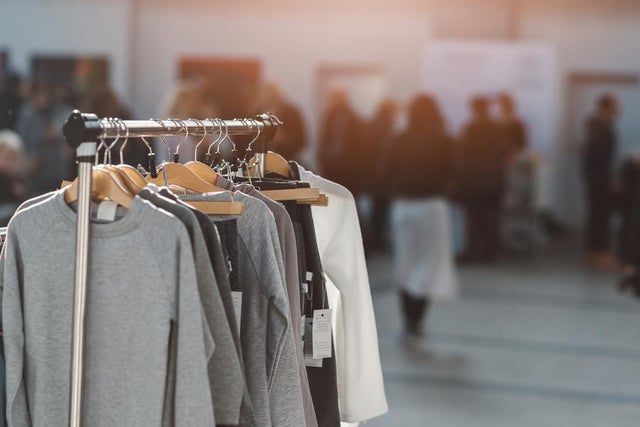
So last week I talked about the labels that we see in our clothes that tell us how to care for our clothes, and this week I am going to talk about the materials that clothes are made from. All clothing should say what it is made from on the same label as the washing instructions. For some of these, you may need to look at the company’s website to determine whether they source these materials sustainably.
Viscose
Also known as rayon, viscose is biodegradable, uses less water than cotton and is affordable. It is often described as the sustainable version of polyester or cotton, and a cheaper version of silk. It’s a great material, but because it is highly sought after, it is often made cheaply, which uses more water, chemicals and has bad working environments.
Wool
Wool is a very popular material, especially as we move into autumn and winter. It’s biodegradable, breathable, and easy to care for, as well as being a natural insulator that can react to your body temperature. However, sheep farming can be unethical when mulesing is used, which is done to prevent flystrike. Sheep farming can also lead to land clearing and degradation. So, when buying wool, it’s best to buy either second hand wool or to look for certifications that tell you the wool is responsibly sourced, such as the Responsible Wool Standard, Soil Association Organic Standards and ZQ Merino Standard labels.
Denim
I’ve mentioned denim before on this blog, as it is a wardrobe staple for most people. Denim production uses a lot of water – 3781 litres for a single pair of jeans! Again, this is because of cotton production. Denim also uses pesticides and dyes, both of which are bad for the environment. A lot of denim manufacturing has bad welfare, particularly a technique called sandblasting is used, which distresses jeans, as sand particles can get trapped in the lungs of workers. In summary, denim is not great, mostly because the supply chain is not well regulated. However, there are lots of companies that do use sustainable denim.
Linen
Linen is biodegradable, fashionable and very strong. It is one of the oldest fibres (and was used by the Egyptians), and it is very versatile, which is what makes it perfect for clothes. It is made from flax plant, and has no unused by-products – like flaxseed and linseed oil, which are both used. Linen also uses a lot less water than other fabrics, and does not hold bacteria. However, because linen has an intense process, it is expensive, so brands shy away from it and it is less affordable for consumers. Like with cotton, it is best to stick to organic linen, and when choosing colours go for natural tones to avoid harsh chemical dyes.
Cotton
Cotton is a completely natural product which is biodegradable, breathable and does not require chemicals to make into products. However, cotton also uses a lot of water, often uses pesticides and has links to slavery, even today. It’s important when buying cotton that you get it from the right places, and to buy clothes made from organic cotton. Organic cotton does not contain chemicals, helps farmers to make money without compromising their health and has less chemical run off. However, cotton does still have a way to go with its process – so make sure that the company that you buy from has clear and good labour policies.
Polyester and Nylon
Both of these fabrics are manmade, sourced from oil and do not biodegrade. Both processes for these materials use a lot of energy, polyester uses a lot of water and nylon produces nitrous oxide, a potent greenhouse gas. Some companies use recycled polyester, which is great, but we should be moving away from the material as much as possible.
Hemp and Bamboo
Hemp is derived from cannabis, and is a completely natural fibre. Similarly to linen, hemp can keep you warm in the winter and cool in the summer, and it can be blended with other fabrics. How is hemp better than linen? Well, it does not require the use of pesticides to grow, requires little water, returns up to 70% of nutrients to the soil and does not require that much land to grow. However, non-organic hemp can be less eco-friendly, as fertilisers that damage the environment can be used. Hemp fabric can be made chemically, or through a process called retting, which is better, and dyes are often used which are not good for the environment. So, although the growing process is great, we have a way to go with the production process. Bamboo is well known as an eco-friendly material, but is it actually that sustainable? Well, bamboo does not need to be replanted after harvesting as it regenerates from the root, it grows quickly and it requires no fertiliser. However, again it is the processing that is the problem. The most popular method of making bamboo into ‘bamboo rayon’ (the clothing material) is through the viscose process, which uses a lot of chemicals which are hazardous to the planet and humans, and are not all recaptured – about 50% to be exact. So, although bamboo is a very sustainable crop, the processing needs to change in order to make it a sustainable material.
Silk
Silk comes from the inner cocoons of silkworms, which are harvested (sometimes using chemicals) and are separated into threads and then reeled together. The silkworms die during this process, so silk is not vegan. However, silkworms are a popular food in parts of Asia, so there is little waste. There are more ethical alternatives to silk, such as ‘peace silk’, as this uses abandoned cocoons. But, these types of silk can be slightly worse for the planet. Whilst the silk industry has played a key part in developing countries, it also has had cases of child slavery, with about 350,000 children working in the industry. So, silk is a bit of a mixed bag – if you are buying silk, always try to buy silk that is OTEX certified (for organic silk) or GOTS certified (peace silk).
Cashmere
Cashmere is a natural fabric which comes from goats, typically from countries like Mongolia, Tibet and Northern India. When the weather gets hotter, the goats shed their coats, which are then collected, sorted and sold. Cashmere used to be very expensive, because it takes about 4 goats worth of coat to make one item, but in modern times the demand is so high that goat herders have increased the number of goats they keep. This not only means that there is more material which is cheaper to produce, but also that there are more goats degrading the land, who sometimes die suddenly if they get too cold from having their coats removed too soon. As with most supply chains, there is not much transparency, so there are concerns for workers rights. Overall, as with most of these materials, it is better to buy recycled or second hand cashmere.
Velvet
Velvet is not actually a material in its own right – it is made from silk, cotton, linen, wool and most commonly polyester. Although normally natural materials are best, as we’ve seen above silk is not very ethical, so that isn’t the best option. However, polyester is also not a good material, as it is manmade, and therefore sheds microfibres when washed. So, velvet inherits the problems of whatever material it is made of, and the best way to buy velvet is to buy something second hand so that there is no new velvet being made.
Leather
People are very critical of fur as a material, but funnily enough we don’t talk about leather as much, even though it is a very similar thing. Is this because leather is a by-product of the meat industry? Well, yes, it was – at first. Once a by-product becomes profitable, it becomes a co-product, because it is just as important as the original product. Therefore, when you buy a leather jacket, you are contributing to the production of leather, not necessarily as a by-product. Globally, the leather industry is valued at $95.4 billion, with much of the leather used coming from veal, as the skin is likely to be untarnished – veal is not eaten as much as it used to be, so how can it be a by-product? Well, it’s not. Just like lowering your meat intake, switching to other fabrics and ditching leather is also a good thing to do – or buying second hand.
Sources:








 Waste Makes Waste