The Importance of Bees

I don’t know about anyone else, but I remember learning about bees and pollen when I was in primary school. It wasn’t that in depth, but I have always had a fondness for bees. We often hear about there not being as many bees on the planet, but why are bees important and what can we do to help? In today’s post, I’ll be talking about what bees do for our planet, what we can learn from them and how we can help to take care of them.

There are over 270 species of bee in the UK, many of which are solitary. One of the most important things to understand about bees in relation to us is that we rely on their pollination to grow food. 90% of wild plants and 75% of global crops need pollination, and 1 in every 3 mouthfuls of food that we consume depends on pollinators. Bees produce honey, they travel along insect pathways between wildlife areas and they can dance! Their communication and cognitive skills are of great interest to scientists, particularly as their brains are the size of a poppy seed, yet they can accomplish complex tasks. So, bees are incredibly important – and I repeat, they dance!

So, bees are amazing and crucial for the planet, but why do we need to protect them? Many species of bee are in decline due to increasing use of pesticides, habitat destruction and the big one – climate change. No bees are protected by law, and we have lost 13 species since 1900, with 35 under threat of extinction. If the demise of many tiny, buzzing lives isn’t enough for you, then there are the parallels with our own struggles against climate change. A lot of the issues that affect bees affect us too. Natural green spaces that provide pollen for bees are great for our mental health, and give us natural spaces to absorb water and heat. Shifts in weather patters, which include droughts and flooding, are bad for us, and bad for bees too, as they are struggling to adapt to intense weather patterns. Increasing use of pesticides which reduce bees’ breeding successes and their resistance to diseases have impacts on us too, as chemicals make their way through the food chain. As bees are so crucial to agriculture, we will see (and are already seeing) affects on global food security as there are fewer pollinators in certain areas. It’s a big risk for us to rely so heavily on a species that is riddled by disease and dwindling in numbers.

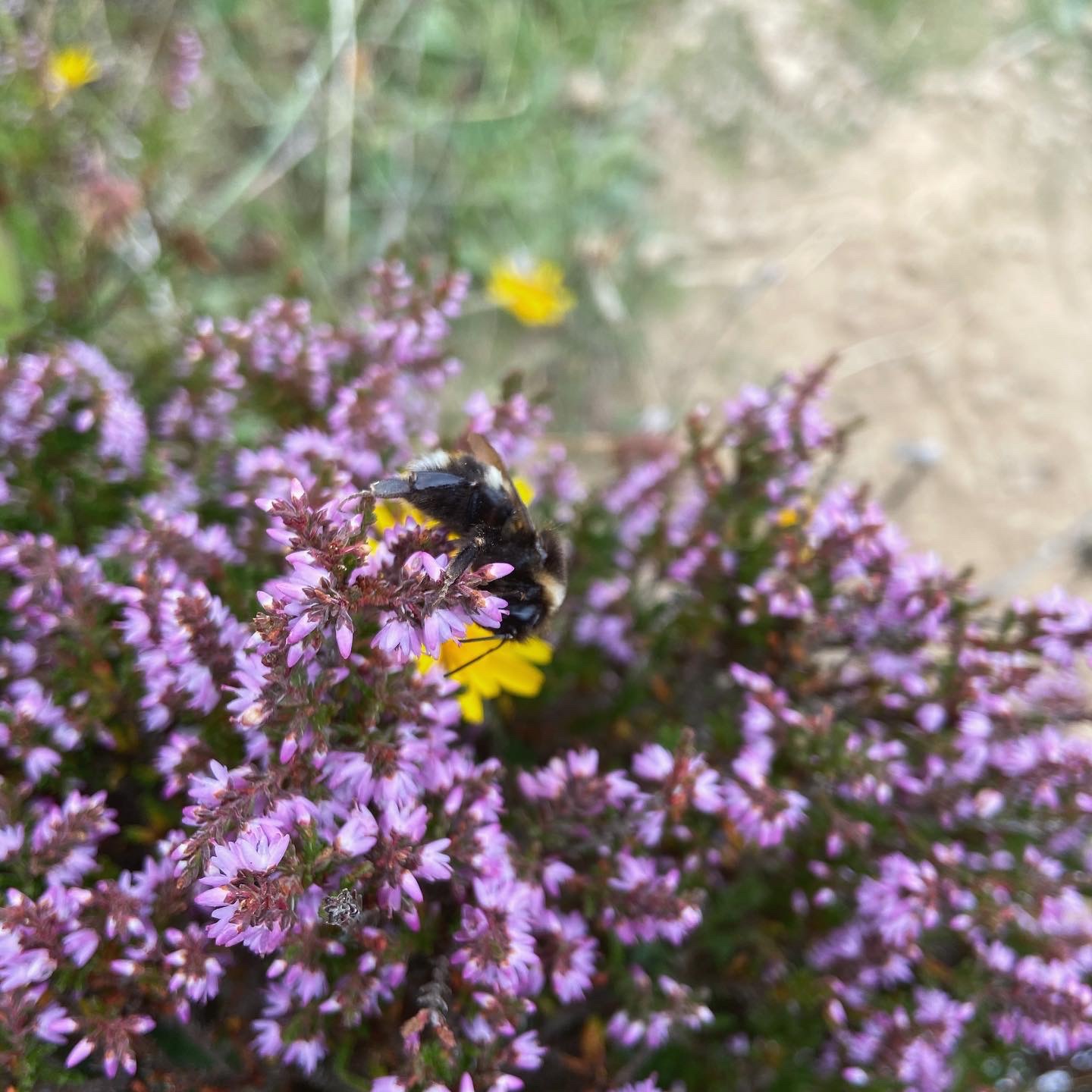
How do we look after bees? If you find a bee that looks like it’s struggling, the best thing to do is to put it on a bee-friendly flower such as lavender, thyme or ivy. If you can’t do this, then make a mixture of half water, half white sugar (not brown sugar or honey), and offer the bee some, allowing it to take it’s time recovering. To encourage more bees into your garden or outdoor space, planting a range of flowers, particularly wild flowers, is really important, as bees need access to pollen all year round. Bees also get pollen from trees, so those are great too. Not using pesticides is also helpful, as synthetic products are harmful to bees – natural products can work just as well. You can also create places for bees to drink from by adding stones to a container full of clean water so that the bees can land on the stones and drink the water at the surface. This is something we have at home, where we filled a small bowl with shells and small stones, and it’s really nice to see the little environment that we have created for them. You can buy or make little hotels for bees that have tubes inside, which are really important for species like mason bees. They may seem like a tiny part of our planet, but it’s crucial that we look after them.

That’s what we can do individually, but collectively we need to campaign for the safety of bees in relation to pesticides and farming and support local beekeepers as much as we can. Asking your local council to think about bees and about local people is super important, as is inspiring your local community to make their outdoor spaces bee friendly. Researching this post just reinforced for me what a big issue climate change is – it can be a little overwhelming to think about how many tiny aspects of life there are for us to fix. However, thinking of it differently – putting some wild flowers in my garden is an easy thing to do, that could be a tiny, microscopic step towards defeating climate change.

Sources:

DIY reusable make-up wipes

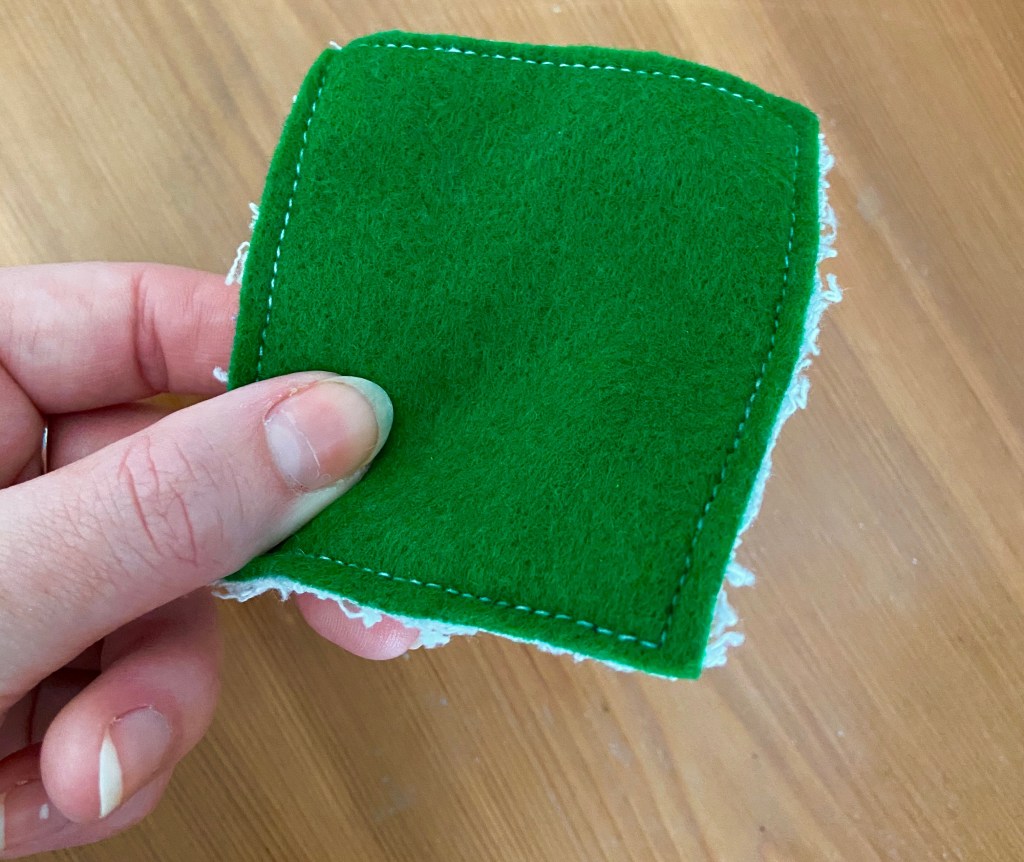
To take my make-up off, I use the Little Green Wood make-up remover pads and coconut oil, which works really well for my skin. However, I get through quite a few of these, and so I wanted to see whether I could make them myself. I happened to have an old towelling dressing gown and some soft green felt, so I decided to use those materials so that they wouldn’t go to waste. I chose square pads to match the ones I already have, but you can do circles if you wish. Much to my surprise, this experiment worked really well, they wash fine and they look really cute. So, here is how I made them!

You will need:
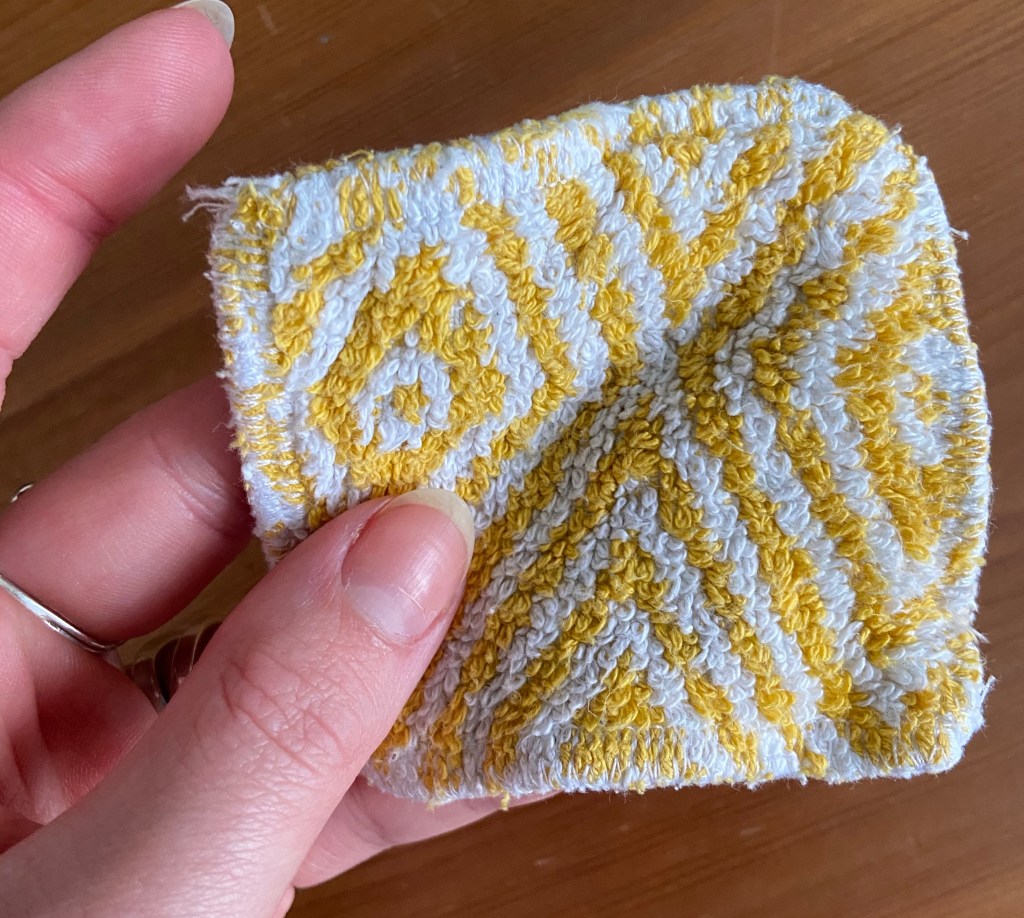
  • Towelling fabric (like flannels, towels, dressing gowns etc, preferably on the softer side)
  • A soft fabric (anything relatively thin and soft will do)
  • A sewing machine (these can be hand sewn, but they may not be as sturdy or washing machine proof)
  • Thread (to match your two fabrics)
  • Scissors
  • Pins
  • Template (I did mine freehand because I wasn’t too bothered about size or shape, but if you’re a stickler for measurements, then this is a good idea)

Method:

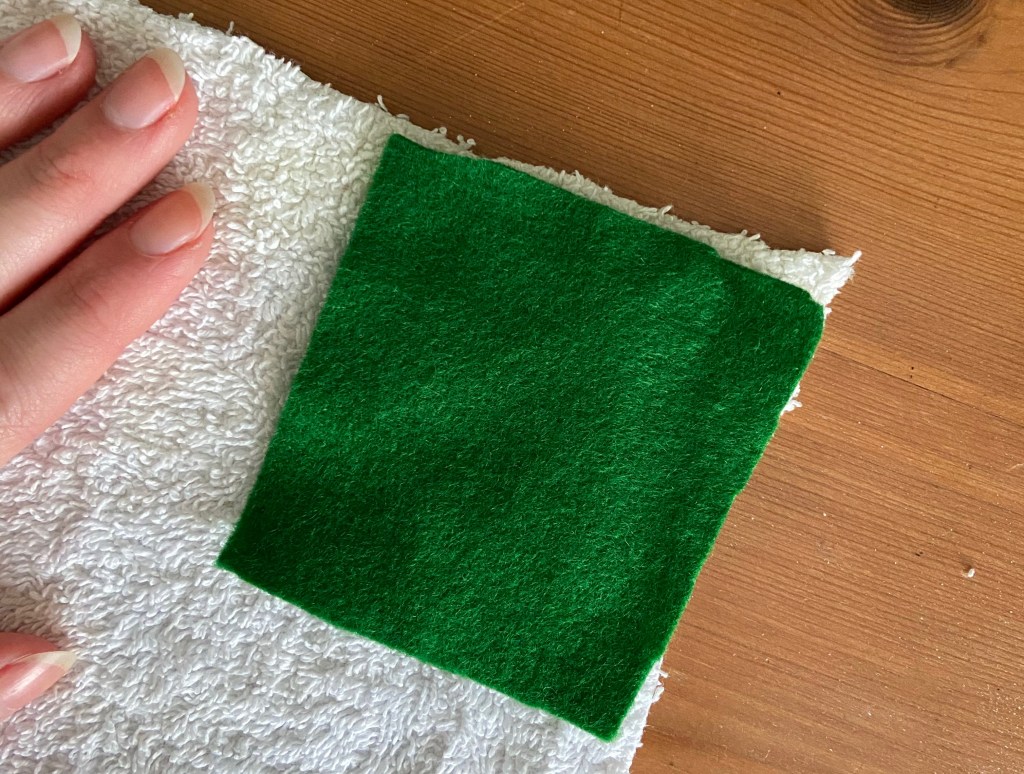
  1. Get your template. You could use a piece of cardboard cut to the shape you want, or if you’re recreating pads you already have, then trace around that. Once you’ve got a template, trace around this on both pieces of fabric. Make sure that they are roughly the same size!
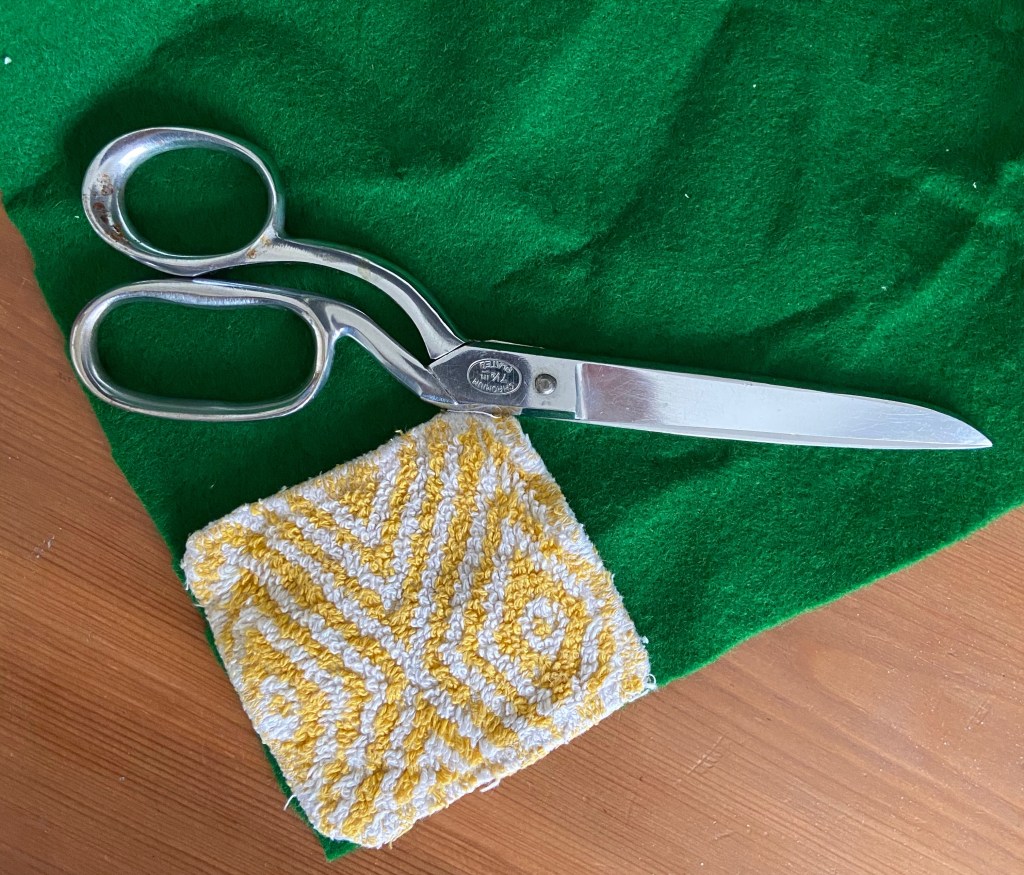
  2. Cut out your pieces, and match the two fabrics together. Once you’re happy with how the edges align, put a couple of pins through to secure them.
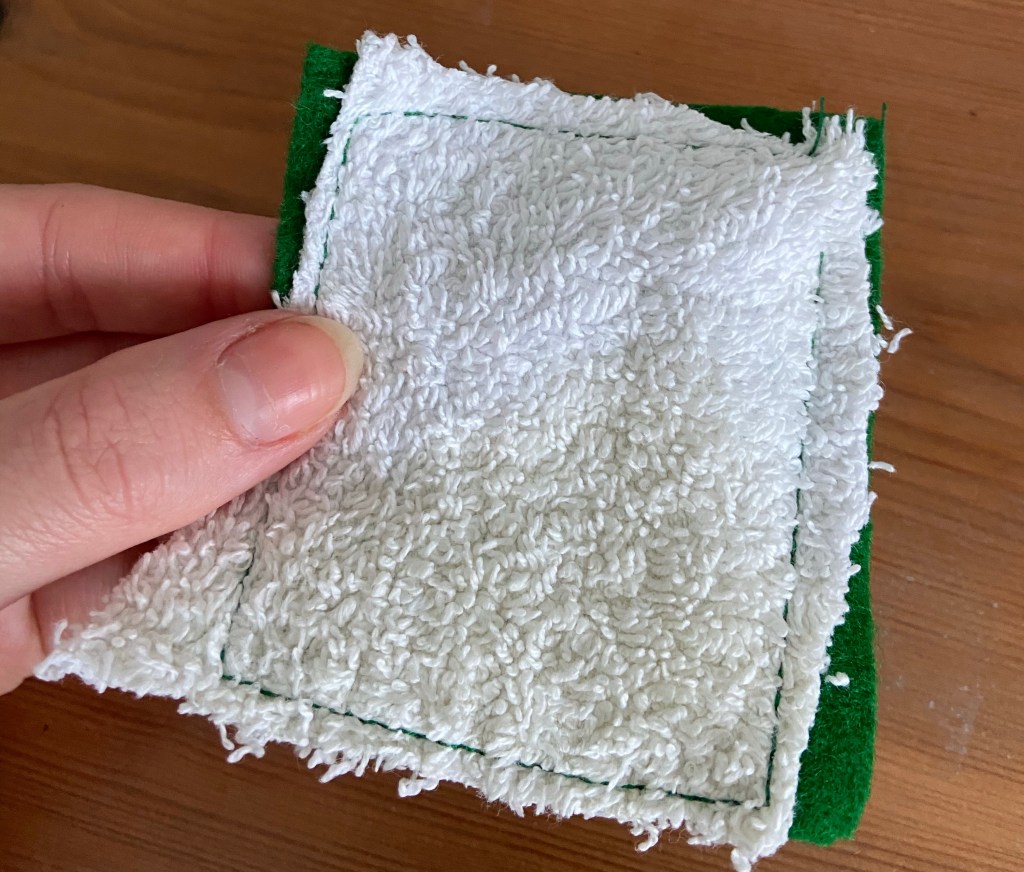
  3. Set up your sewing machine. I did my pads with contrasting thread (as pictured), but if you’re not confident sewing straight lines, then maybe choose thread that is the same colour as your materials.
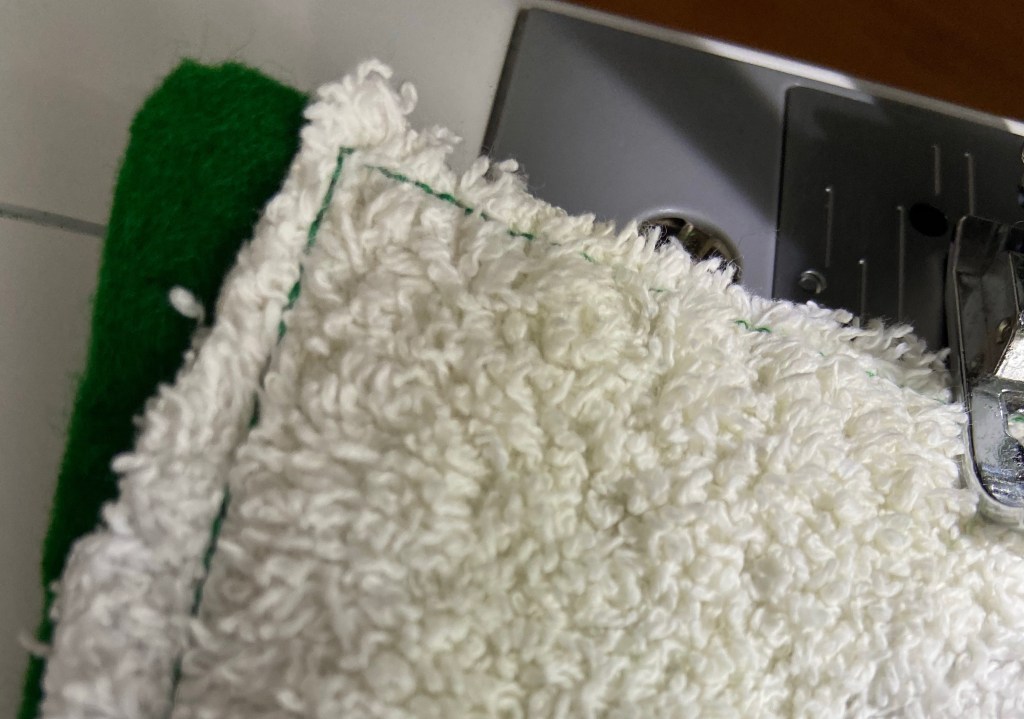
  4. Sew straight lines down all four sides of your pads (or around the edge if you are doing circles).
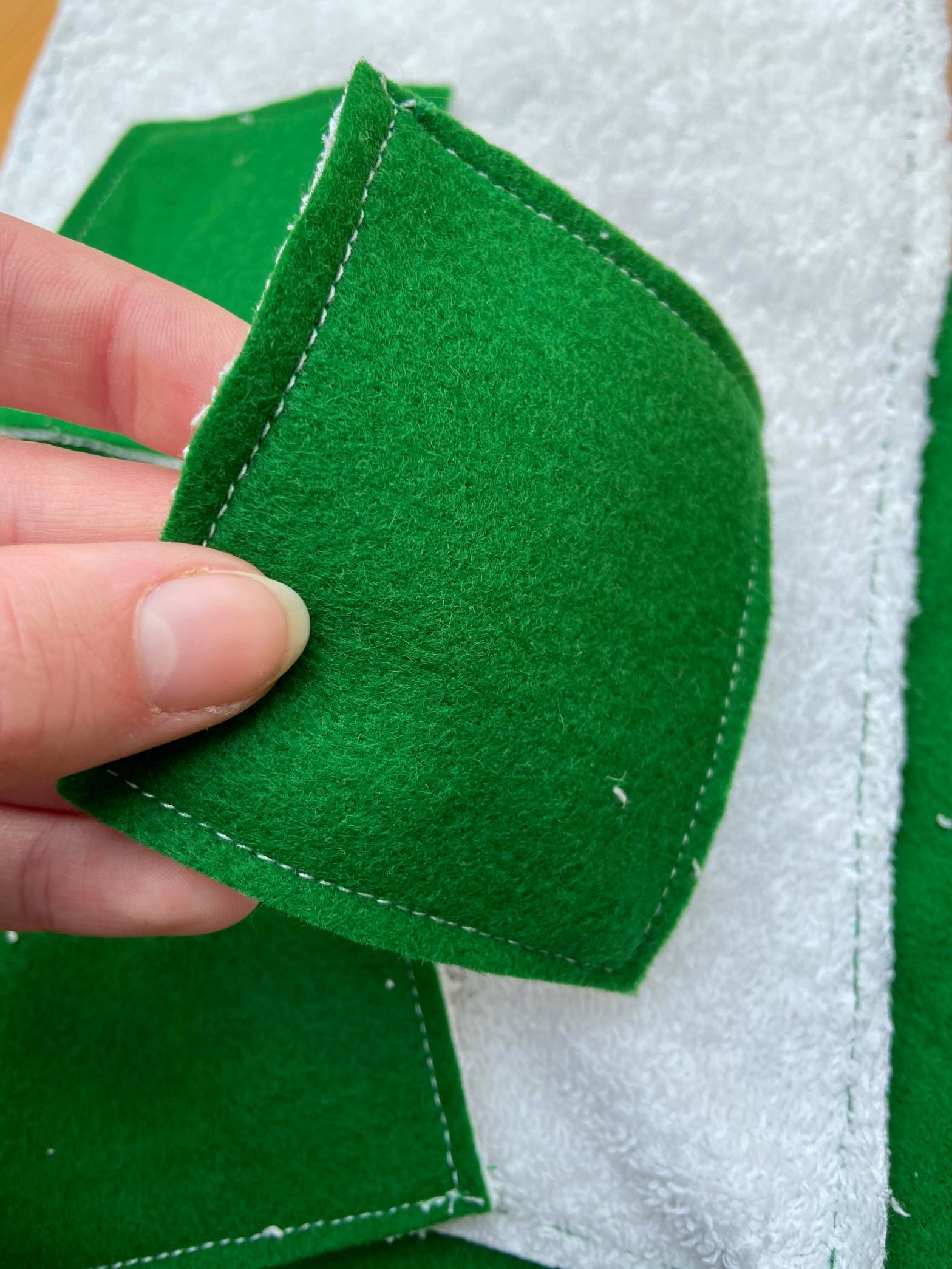
  5. Finally, cut around the edges until they are even. For me, this was really crucial, because the fabric tended to bunch up when sewn – if this isn’t a problem for you, then you may not need to cut around the edges.

Method in pictures:

Choosing your template
Cutting out the fabric
Matching the fabric
Sewing around the edges
Neaten up the edges
All finished!

That’s it! I’d recommend testing one out before you make large numbers, and possibly putting it through the wash just to be safe (especially if it is hand sewn!). But, hopefully this is a nice way to use up any fabric you have. Because this is a little bit more technically tricky, please comment if you have any questions, or DM me, and I’ll try to help as best I can. I’ve also posted an IGTV tutorial for this on my Instagram if that’s helpful. Thanks for reading!

How About… Palm Oil?

Palm Oil is in everything, from lipstick to pizza – but what is it? And why is it bad for the environment? In this post, I’m going to talk about what it is, where it comes from, why it’s a problem, and how we can help.

What is it? Palm Oil is a type of vegetable oil that comes from palm trees known as Elaeis Guineensis. These palm trees are native to Africa but were brought to south-east Asia about 100 years ago. 85% of the global supply comes from Indonesia and Malasia, with 45 other countries also making it. The oil is extremely versatile as it is semi-solid at room temperature, resistant to oxidisation, stable at high temperatures, odourless and colourless. Therefore, it doesn’t alter the look or smell of food and is great for spreads, longer shelf-lives, and keeping things crunchy.

Why is it a problem? The production of Palm Oil can have several environmental problems. Firstly, it is a major cause of deforestation as land is cleared to create space for the crop. This destroys the habitats of animals like orangutans, pygmy elephants and sumatran rhinos. Deforestation removes trees which allows more CO2 to be released. A common method of deforestation is burning, which also produces CO2, especially when peat fires are created, which are harder to put out. This process creates carbon sinks, which produce more carbon per unit area than any other ecosystem in the world. Palm Oil production can also create freshwater pollution, as 2.5 metric tons of liquid waste is produced for every metric ton of oil. Soil erosion is also a threat when oil palms are planted on steep slopes, which causes flooding. Therefore, unsustainable Palm Oil production is a huge problem.

So, what is it in? It’s in almost 50% of what is on our shelves. Palm Oil can appear under the following names: Vegetable Oil, Vegetable Fat, Palm Kernel, Palm Kernel Oil, Palm Fruit Oil, Palmate, Palmitate, Palmolein, Glyceryl, Stearate, Stearic Acid, Elaeis Guineensis, Palmitic Acid, Palm Stearine, Palmitoyl Oxostearamide, Palmitoyl Tetrapeptide-3, Sodium Laureth Sulfate, Sodium Lauryl Sulfate, Sodium Kernelate, Sodium Palm Kernelate, Sodium Lauryl Lactylate/Sulphate, Hyrated Palm Glycerides, Etyl Palmitate, Octyl Palmitate and Palmityl Alcohol. It can be in products like pizza, deodorant, shampoo, chocolate, doughnuts, toothpaste and lipstick. It is also used in biofuels and animal feed in some countries. So, it’s in more things than you think, and because it isn’t always listed in ingredients lists as the same thing, it can be tricky to spot.

Finally, what can we do about it? Well, products can be made with sustainable palm oil, and if they are, then the product will be RSPO certified. Crucially, Palm Oil is important for the GDP of developing countries, so boycotting Palm Oil altogether is not the answer. Instead, lobbying for change is more effective. By 2016 75% of the Palm Oil in the UK was sustainable, so now there needs to be a push to 100%. So, encourage change, support businesses that use Palm Oil sustainably, and buy RSPO certified products.

Sources:

All About Tofu

Tofu is one of my favourite foods, especially because it’s so versatile. It’s great as a replacement for meat, and (despite what the internet might make you think), it’s been around for a long time, so there are a lot of options for recipes. I thought I’d discuss the environmental impact of tofu versus meat, and a few of the recipes I make with tofu.

Tofu, like all foods, has an impact on the environment. It is regularly criticised because it is made from soya, which is often sourced from the amazon (but not exclusively) and is a cause of deforestation. Soya is mostly farmed to feed to livestock, but if the world was to swap from meat to tofu, then the production of soya would still be an issue, the source would just change. However, despite tofu having it’s problems, a plant based diet is still much better for the environment than an animal product based one, as ‘livestock products directly account for nearly two-thirds of food greenhouse gas emissions while providing less than a third of food energy’. And, if soya was only used for human consumption, then at least it would come straight to us instead of going through cows.

So, with that in mind, here are some recipes! I tend to use tofu as a replacement for chicken, so most of these recipes are suitable for chicken too.

Curry Paste Tofu

This is an excellent dinner option, and as I always have leftovers, an excellent lunch the next day. It’s really simple, and requires 3 ingredients – tofu, curry paste (of your choice, I use tikka masala paste) and yogurt (natural yogurt, vegan or not). Firstly, press your tofu if you need to, then chop up or tear it. Then, add about 3 table spoons of your curry paste to a bowl – this may change depending on how spicy you want your tofu. Add your tofu and coat it in the paste, then add enough yogurt to cover it. Mix, then leave this to marinate for at least a couple of hours, and then transfer to an oven proof dish. Heat your grill to a medium heat and put the tofu underneath to cook. You basically have to do this by eye, so when you see bits catching and going black, take the tofu out and shake it around a bit before putting it back in. Once it’s cooked, I serve it with rice and green veg. Just keep it in the fridge after this if you want it for lunches.

Soy sauce, mustard and honey tofu

Pretty explanatory really. Prepare your tofu and tear it into chunks, then set aside. Combine 1 tbsp mustard, 2 tbsp honey, 3 tbsp soy sauce and 1 chopped clove of garlic in a bowl and add the tofu. Marinate for a few hours, then toss in some sesame seeds and either pan fry or bake until crispy. You can change the amount of each ingredient depending on your taste. I tend to serve as part of a stir fry with veg and noodles.

Chilli and Lime tofu

Again, pretty self explanatory. Tear your tofu and set aside. Then chop up a fresh chilli, and add as much as you can handle to a bowl. Then, add the juice of half a lime, half a teaspoon of cumin seeds and some salt and pepper. Add your tofu, marinate for a few hours, and then fry or bake until crispy. This is something I tend to do for wraps, or with rice, and it works really well for lunch.

I hope that you enjoy these recipes, particularly if you haven’t had tofu before, and if you give them a go then please let me know!

Sources:

How About… Heatwaves?

The great British summer – promised rain, a few days of sun and then more promised rain. Right? Not necessarily. It’s no secret that the weather is getting warmer, and has been for years. But that’s good news for our sun tans, ice cream shops and washing lines, so it’s not that bad – we all go on holiday for the heat, so we won’t need to. Right?

Absolutely not. Since 1880, the combined land and ocean temperature has increased at an average rate of 0.07°C per decade. That’s not much, is it? Well, the average rate of increase since 1981 (0.18°C) is more than twice as great (Climate.gov). Basically, we have done the most damage in the past 40 years. But a couple of degrees isn’t a big deal – we see these changes in temperature everyday. Well, a one degree global increase is not the same as a local one degree increase throughout the day. These temperatures fluctuate due to things like time of day and season, whereas a global temperature increase is the average temperature of everything. If everything – the land, sea and atmosphere – has risen by 1 degree, then it has to have been very, very warm.

So the planet is heating up, but everyone loves hot weather so this isn’t a problem, is it? Sadly, it really is. If our planet continues to warm like this, then in the future we will see more drought and wildfires, like those we’ve seen in Australia recently, and whole ecosystems could potentially disappear. Agriculture would also be hit, as crops often require certain temperatures to grow, and animals become heat stressed, which would affect food production.

For humans, there are a number of issues that could come with higher temperatures, if the planet continues to warm as it is. There is the possibility that tropical diseases may become more common in parts of the world where they were not a problem, and diseases that we have evolved to kill off using our body temperature will be better equipped to survive higher temperatures. Respiratory, cardiovascular and kidney problems could become more common, and heatstroke or other heat related illnesses could be constant daily struggles. Outdoor work could become practically impossible, as temperatures and humidity become too much to handle. As increasing temperatures are caused by greenhouse gases, air pollution will also be a huge problem (even more so than it already is). This won’t be helped by the excessive use of air conditioning which uses electricity, which sometimes can produce more pollution.

In The Future We Choose by Christiana Figueres and Tom Rivett-Carnac, they paint a picture of two worlds – one that will happen if we do not stop pumping greenhouse gases into the atmosphere, and one that could happen if we do everything in our power, as the human race, to become carbon neutral. The things I’ve mentioned above are just the start, if we do nothing. But we do not have to do nothing. The Future We Choose presents us with this choice, and to me, it seems an easy one.

Sources:

Carbon Footprint

Hello! So, as we all start to emerge from our homes and out into the world again, I wanted to talk about Carbon Footprints – what they are, how they can be reduced and why they are important. Right now, everyone wants to get back to ‘normal’, and I for one am concerned that this will mean more cars on the road, over-consumption and over-production. So, I thought it would be good to discuss our impact on the world, and to think about how we can reduce this impact as we move forward.

A Carbon Footprint is defined as ‘the amount of carbon dioxide released into the atmosphere as a result of the activities of a particular individual, organisation or community’. This is something that each person is accountable for based on what they eat, how they travel, where they live and how they buy. Virtually everything we do releases an amount of carbon, it just depends what that thing is to determine the quantity of carbon. Making clothes produces carbon, driving a car produces carbon, heating your home produces carbon – and all these things add up.

Why is this bad? Carbon dioxide, and other greenhouse gases, trap heat inside the atmosphere, which causes global warming. This has been happening gradually for a long time, as ‘humans have increased the abundance of carbon dioxide by 45 percent since the beginning of the Industrial Age’ (NASA). So basically, the atmosphere is used to putting up with this. However, water systems, the carbon cycle and others are not. We rely on these cycles and systems to survive, and because of our affect on the atmosphere, these are changing rapidly. Too rapidly. According to NASA, ‘half of the increase in atmospheric carbon dioxide concentrations in the last 300 years has occurred since 1980, and one quarter of it since 2000’ – so significant changes are happening very quickly.

So basically, in order to save the planet, we have to release a LOT less CO2 (and all the other greenhouse gases). In an ideal scenario, we would all become carbon neutral, where we produce next to no CO2. However, right now, that is very difficult, because it would involve stopping using petrol altogether and swapping to a renewable source, which isn’t entirely feasible at the moment due to the supply chain. So what do we do? Lower it as much as we can. A great way to see where you’re starting from is to use a Carbon Footprint calculator. The WWF one is the one that I used, which I’ll link down below. Based on that, you can look at how you can improve, and if it is doable, start making changes.

I thought it would be fun to show you how I did on this! My Carbon Footprint came out as 101%, with the percentages being divided like so:

  • Food – 14%
  • Home – 34%
  • Travel – 25%
  • Stuff – 27%

The quiz estimated my carbon footprint at 10.6 tonnes, and the 2020 target is 10.5 tonnes – so not too bad right? Yes and no. I’m really happy about the food category because it’s something I try to work really hard on by being vegetarian and buying locally and seasonally. I’m also pretty happy with travel, as this will be lower once I feel comfortable getting on buses again! I normally use a park and ride service to get to work, but at the moment this is not really doable for me, so I’m driving more. The home category is somewhat out of my control because I live with my parents, however we are looking at getting solar panels, so I feel pretty good about this too. The one I’m not so happy about is ‘stuff’. I recently bought a new phone, which is one of the reasons that this is so high. In the future, I want to look at buying second hand electronics so that this has less of an impact on my carbon footprint.

Overall, this isn’t too bad, but we can all improve! I hope that this was somewhat helpful, and I encourage you to have a long, hard look at your Carbon Footprint.

Sources:

Covid-19 and Plastic

Plastic. It’s in our oceans, it’s in our recycling and it is in everything we buy. In the past few years plastic has been a big topic of conversation, which has led to people being more aware of how much of it they use, and in some cases reducing it (yay!). However, once Covid-19 hit, we began to see more and more plastic out and about. We need it, in some places, to protect our key workers with shields and visors, but do we need it everywhere else? And how good is it at protecting us?

At the moment, plastic gives us reassurance. If something is wrapped in plastic, like food, then it means it’s safe, right? Well, a study (linked below), found that the virus can survive for 24 hours on paper, but can survive for 72 hours on plastic. Therefore, is plastic actually any safer than other packaging materials? This confidence in plastic which is based on the idea that plastic is ‘safe’, has led to many countries slowing down, or stopping altogether, their bans on single use plastic. For example, in the UK, we have postponed our ban on single use plastic which was supposed to go ahead this year. It has also led to some supermarkets banning the use of reusable bags. These increases in plastic could become permanent, which is a huge step back, especially when there is evidence to suggest that plastic is not actually that safe. Just to be clear, I’m not talking about PPE here – I’m talking about the amount of plastic that has resurfaced onto our supermarket shelves, and the number of single use masks that are floating around on the streets.

But plastic is recycled, right? Not always. Because the amount of plastic that we use has risen, the amount we recycle has also risen – which puts more pressure on the recycling industry. This is felt particularly by informal waste pickers in countries like Indonesia, who need support from the private sector so that they can keep workers safe with gloves and masks. And if plastic is not recycled, it has to go somewhere. Disposable masks have been found in oceans, floating like jellyfish. An estimated 13 million tonnes of plastic goes into the ocean every year (UN Environment, 2018), with 570,000 tonnes going into the Mediterranean every year. This is equivalent to 33,800 plastic bottles per minute. So that is already a problem. Then, we have the problem that many disposable masks are made of polypropylene, which has a lifespan on 450 years! There is no such thing as disposable folks – it all has to go somewhere.

So what are the alternatives? Again, I’m not talking about the provisions to keep everyone safe – I’m talking about the little things that we can do:

  • Masks – you can get cloth masks which are just as effective as disposable ones (and honestly, they’re pretty cute). You just wear them, then wash them as soon as you take it off.
  • Taking your reusable bags instead of single use plastic ones – a lot of supermarkets still encourage this. And again, if your bag is a material, like canvas, you can just throw it in the wash to make sure it is safe.
  • Buying loose fruit and veg where you can – I have been going to my local supermarket once a week, and I always try to buy my fruit and veg loose. When I get home, I wash it all anyway, so really buying it in plastic is just another thing to clean!
  • Zero waste shops – I’ve used a few around me, they were great for when the supermarkets ran out of everything! There’s no reason why we can’t shop at the places we want to, as long as it’s safe, which it is. Have a look at your local zero waste shop, and see how they’re dealing with the situation – do they do click and collect? Or delivery? Or are they open with restrictions? If you’re happy with how they’re operating, give them a go – I’m sure they’d love your support. I’ll link some of my local zero waste shops below if you’re in the York-Leeds area.

As they keep saying on the news, these are unprecedented times, but if we keep treating the environment like a giant waste disposal, and believing that we can throw things into the magical land of ‘away’, we’ll face even more challenges in the years to come. Stay safe and maybe use a little less plastic.

Sources:

Study: https://www.nejm.org/doi/pdf/10.1056/NEJMc2004973?articleTools=true

Protector or polluter? The impact of COVID-19 on the movement to end plastic waste: https://www.weforum.org/agenda/2020/05/plastic-pollution-waste-pandemic-covid19-coronavirus-recycling-sustainability/

The Amount Of Plastic Waste Is Surging Because Of The Coronavirus Pandemic: https://www.forbes.com/sites/lauratenenbaum/2020/04/25/plastic-waste-during-the-time-of-covid-19/#4606425f7e48

‘More masks than jellyfish’: coronavirus waste ends up in ocean: https://www.theguardian.com/environment/2020/jun/08/more-masks-than-jellyfish-coronavirus-waste-ends-up-in-ocean

Zero Waste shops (Leeds-York)

The JarTree: http://www.thejartree.co.uk/

Refill and Go: https://www.refillandgo.co.uk/

Ecotopia: https://www.ecotopialeeds.co.uk/

The Bishy Weigh: https://www.thebishyweigh.co.uk/

Adapting Clothes

I can’t be the only one that has cleared out their wardrobe during lockdown and realised two things. Firstly, how many clothes they have that they love but never wear, and secondly how many clothes they have that they never wear because they don’t love them. This blog post is about the latter. I had a couple of clothing items that I couldn’t wear because they were in bad condition, didn’t wear because I didn’t like them anymore, or wouldn’t wear them because they were nothing special. Here are three ways that I adapted my clothes.

Bleach Tie Dye (Reverse Tie Dye)

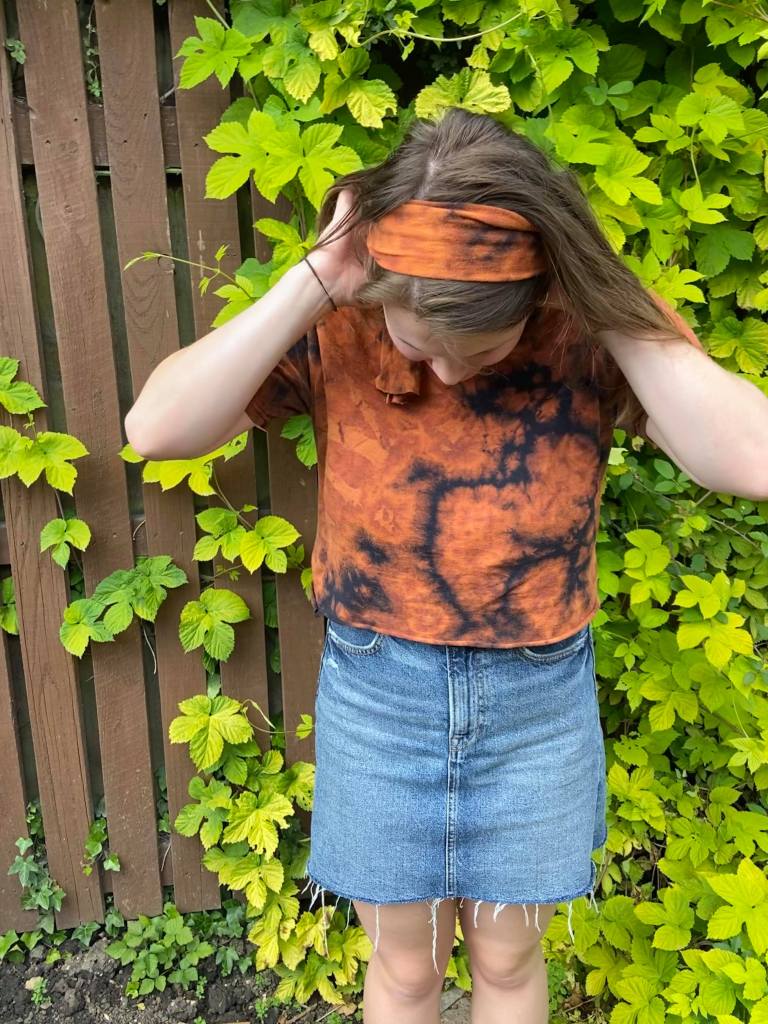
Because I used to work in a cafe where the uniform was all black, I have a lot of plain black t-shirts. Whilst it’s useful to keep some, I rarely wear them, and so I wanted to make them more exciting. I read about people using bleach to tie dye things, so I decided to give it a go. I’ll link the video that I used below, but the basic premise is that you either scrunch, twist or ball up your item, then secure it with rubber bands. Then, you use a squirt bottle to pour the bleach over the item and leave it for a few hours. Once it has sat in the bleach for a while, you rinse out the bleach with cold water, then put it through a quick wash in a washing machine, and finally leave it to dry. I ended up cropping this t-shirt, which left me with a strip of fabric which I decided to use as a headband. This was a great DIY for me, as it is really easy and highly effective – I’ll definitely be wearing this t-shirt more now.

Geometric Embroidery

This one is a little less straightforward. If you have never embroidered something before, maybe consider trying a simple pattern, and have a look at lots of ideas before you decide on one.

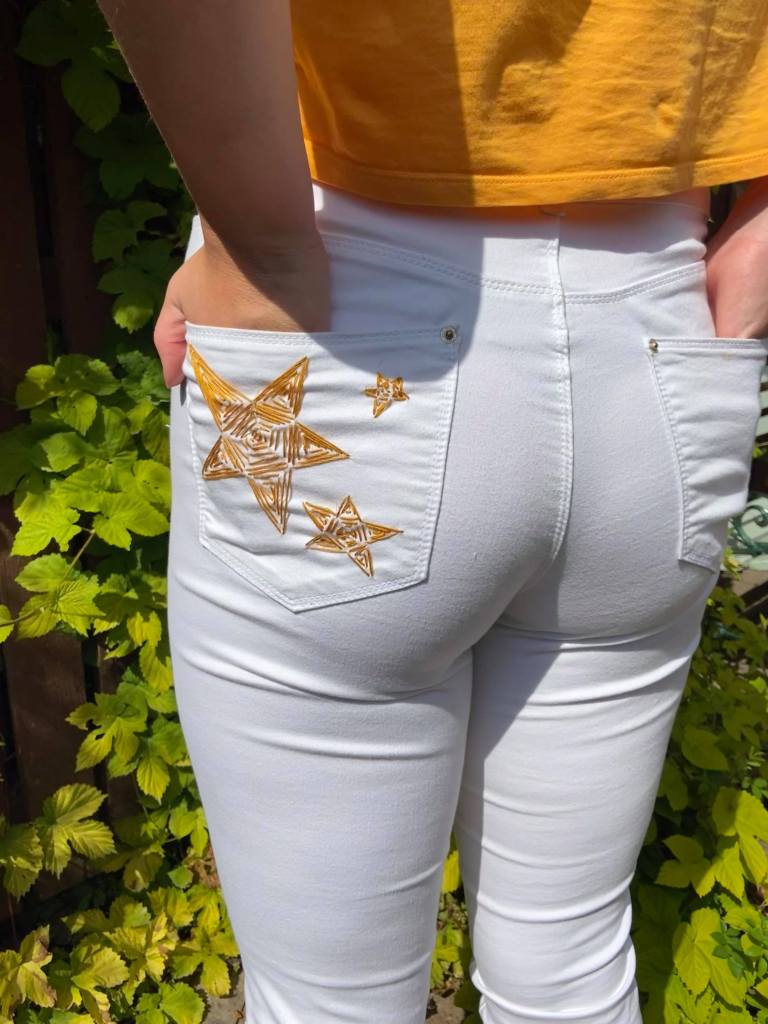
I had a pair of white jeans that I never wear because they’re a little bit boring and don’t really go with anything I own. So, the way I created this pattern was by tracing some stars out on pieces of paper and then laying them out on the jeans so I could see what it looks like. This is a pretty crucial step regardless of your pattern, because it shows you roughly what it will look like. Next, I sewed around the stars with white thread to get the shape. Then, I went in with gold embroidery thread – if you don’t have embroidery thread, you can just use cotton, it will just take a bit longer. I basically just filled in the stars with triangles until there were no gaps, then I got rid of the white thread and tidied the threads on the inside. It’s a little fiddly on a pocket, but I find it very therapeutic!

Finer Embroidery

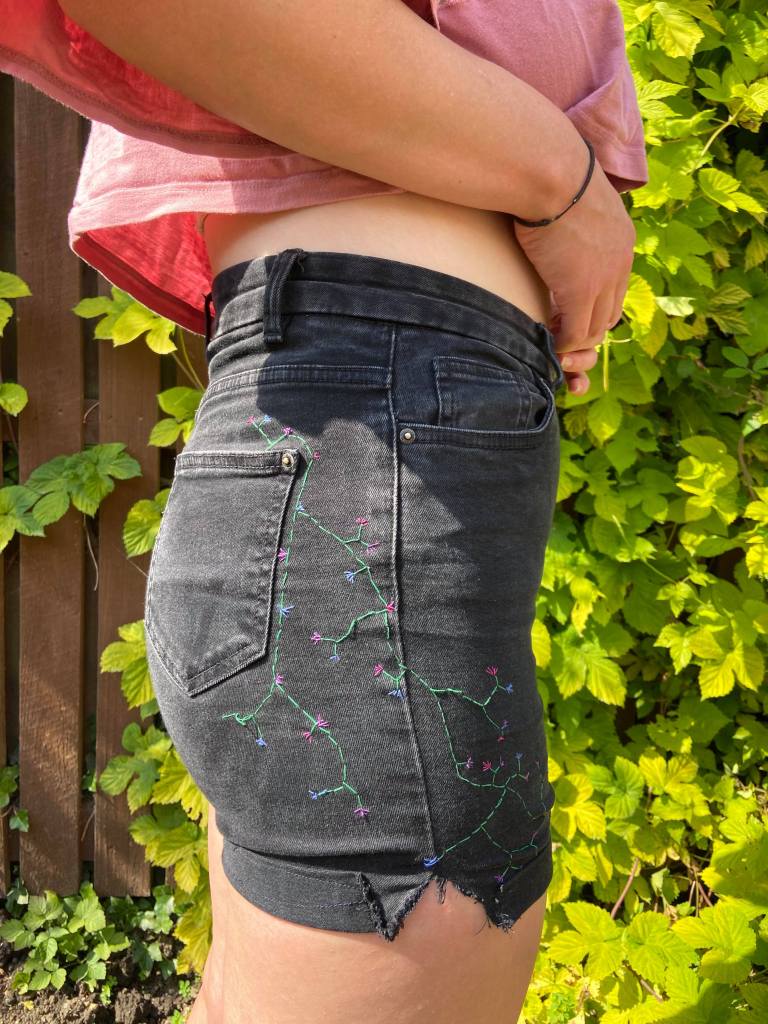
Finally, the most time consuming and fiddly of the three. I had a pair of black jeans that had gone in holes around the thighs, so I cut the legs off and rolled them up, but then they were a little bit dull. So I decided to embroider them. The only real difference between this and the previous DIY is that I added detail in more places, which is why it is more time consuming. Like last time, I drew out the pattern, but this time I drew it onto the shorts with chalk, so that I could follow the pattern as I went. I started with green thread, then went back with different colours. Again, maybe don’t attempt this if you’ve never sewn before, or if you have no patience, but if you can give it a go, it can look really pretty.

So there we go, that’s how I’ve been editing my clothes so that I actually want to wear them again. It’s really important at the moment (in terms of fast fashion) to use what we have as much as we can, and to support small businesses as much as possible. Yes, we need to restart the economy, but that will happen without everyone going out and buying 5 pairs of jeans because they were on sale – it’s not good for the workers or the environment. Instead, let’s get creative!

Sources

Bleach Tie Dye: https://www.youtube.com/watch?v=1BSwUyJwvKw&t=211s

The many uses for jars

I am slightly jar obsessed – as soon as we finish something that comes in a jar, I wash it out and try to use it for something else. I see a lot of ads for storage containers, mostly for food, and whilst some of them are really useful and necessary, glass jars are really versatile and something you already have (if you buy stuff in glass jars). Below, I’ve listed some of the ways I use jars around my home, including a couple of little craft projects!

Food Storage

The most obvious use of jars is to store food. This is really straightforward with big jars that you can purchase specifically for storing things like spaghetti, flour and other foods that come in big quantities. Using the smaller ones can be harder, but there are loads of things in our kitchens that you can often get in smaller quantities. For example, I use small jars (think like honey sized jars) for loose teas like earl grey, peppermint and green. I don’t drink large quantities of these teas, therefore it’s easy for me to use small jars to store them. This also goes for nuts and seeds, which I also have in small quantities. The smallest jars I use in the kitchen are the ones that spices usually come in. For these, I tend to reuse them for spice rubs to use in curries, on tofu or in soups.

Cosmetic Storage

I’ve mentioned this in a couple of posts, but I use jars to store the cosmetic things I use like face masks and scrubs. I have a couple of tiny jam jars that I use for things like my lip scrub (which was featured in my last post), coconut oil and dry shampoo. These jars are just the right size for small quantities like this. The bigger jars I use for face masks, scrubs and more coconut oil (of course). One that is a little bit more strange, is the candle holder that I use to keep cotton buds* in. This is more of an aesthetic thing to be honest – I love having them within reach and they look really cute. Again, this candle holder is the perfect size for them.

Candles

I love candles, and I particularly love having them in things other than candle holders. There are two little creative projects that I’d like to talk about here. The first is about the small ramekins that puddings come in from the supermarket. I haven’t bought any of these in a long time, but the last time that I did, I saved the glass, and I now use them for candles. The only thing about this that is slightly DIY is fitting the candle into the holder. All I did was put the candle into some hot water until it was soft, and then cram it into the holder. I then put any excess wax into the gaps. These are really cute, and although they involve a tiny bit of effort, it’s really not a lot.

The second is a little more artistic. I love painting, and some of my old watercolours have gone hard and are not very usable anymore. So, I got some different jars that I wanted to make into tealight holders, specifically for outside in the garden. I selected a couple of colours, then dribbled them into the jars. Then, I put about a teaspoon of water into the jar, and swirled the colours around with a paintbrush. I dried them upside down in the sun, and turned them over when they were almost dry. Because the paint is on the inside, you get really pretty colours when you light the candles! I love these, particularly for summer, because they’re bright and colourful, and you can keep them and use them. Once you don’t want to use them anymore, you can wash the watercolour out and recycle them.

I hope that this post maybe opened you up to a few more ways of using jars – are there any others that I haven’t mentioned that you do? As always, thanks for reading, I hope everyone is well!

Sources:

*Cotton Buds – the cotton buds I use are biodegradable bamboo cotton buds by Just Little Changes.

Sugar Scrubs

Hello! After talking about the coffee scrub the other day, I started looking at the other scrubs that I use in my own routine. One of the ingredients that came up a few times was sugar, so this week I’m going to tell you about 3 recipes that I use that involve sugar. They are a lip scrub, an exfoliator for your face and a brightening scrub. As I said in the last post, always do a patch test with these recipes just in case!

For all of these recipes I have used brown sugar because a) it’s what I had, and b) it’s chunky, so I feel it exfoliates my skin better. If you have sensitive skin, it’s best to use a softer sugar that is finer, like caster sugar, but just give it a try with what you’ve got and use the right amount for your skin.

Lip Scrub

This is a really great scrub to use for when your lips are a bit dry and cracked because it exfoliates the dry skin and moisturises them at the same time. You will need 3 ingredients: Sugar, vaseline and coconut oil. Now, some of you may be thinking, ‘you can’t get vaseline zero waste, so this isn’t good for the environment!’ This is true, vaseline does come in packaging, however it comes in tins which I save and reuse for things like this lip scrub. If you don’t have vaseline, then you can just substitute extra coconut oil. The basic recipe that I used was about a tablespoon of the vaseline and sugar, and half a teaspoon of melted coconut oil. Then you just mix them together, making sure to distribute the sugar evenly. To use it, you just scrub it onto your lips and then wipe it off with a little bit of water! As tasty as it may seem, don’t try and eat it – I’m not sure that ingesting vaseline is a great idea.

The Exfoliator

One of the skin products that I really missed when I started changing my beauty products for zero waste ones was an exfoliator I used to swear by. It always left my skin feeling completely smooth and not irritated at all. This scrub is a wonderful alternative for me. Again, you need 3 ingredients: Sugar, coconut oil and lemon juice. You can also add honey to this if you like (because it has antibacterial properties), but I chose to leave this out because it has irritated my skin in the past. For the method, I combined 2 parts coconut oil to 1 part sugar and about a tablespoon of lemon juice. If you want a more abrasive scrub, just up the amount of sugar. If you want it to be more moisturising, add more coconut oil. Be careful with the amount of lemon juice you use, because it can loosen the texture a bit too much. To use, just scrub it onto your face (over a sink, because it can get messy) and wipe off with a flannel.

Brightening Scrub

This is a ridiculously easy recipe – it’s a one off type of thing, similar to doing a face mask. You only need 2 ingredients – sugar and a lemon. Cut the lemon in half and dip it into the sugar. Then, rub the end covered in sugar onto your face to exfoliate it. Wash it all off, and your skin will look a bit brighter and feel softer. Try to avoid direct sunlight after doing this. This is something that I’ve been doing for many years, even before I started looking at my waste. The original recipe comes from the YouTube beauty sensation, Michelle Phan – I’ve linked her video down below. It’s really easy and funnily enough, very tasty when you eat it by accident.

So, there are the three recipes! I hope you enjoy making and using them all. Because they are all great for exfoliating, you shouldn’t use them all the time, because it will be too rough on your skin, and always moisturise afterwards! Thanks for reading.

Sources:

Michelle Phan: https://www.youtube.com/watch?v=xXU_ylBSpbw

Design a site like this with WordPress.com
Get started