Coffee Scrub

This week, I wanted to share one of my favourite zero waste beauty products that you can make yourself. I’m a coffee drinker, and although I can compost the coffee grounds, it’s nice making them into something to use again. This scrub is great for exfoliating and moisturising the body – it’s not suitable for your face, so please don’t use it there! As with anything that you put on your face or body, you should always do a patch test in a small area to make sure that nothing reacts badly with your skin – even if the ingredients are things that you are not allergic to when you eat. Anyway, I hope you enjoy this simple scrub!

Ingredients:

  • Coffee grounds (not instant)
  • Coconut oil or olive oil – I’ve used both coconut oil and olive oil, and both work for me. Olive oil makes a looser mixture, whilst coconut oil makes more of a thick paste, so it’s all down to personal preference. If you use coconut oil, make sure to melt it so that it is easier to mix in, and then it will cool down and firm up.
  • A container
  • Essential oil (optional) – I don’t add any essential oils because I love the smell of coffee, but if you like you can add different smells to the scrub. Just remember to account for it when you add your oil!

Method:

  1. First, take your coffee grounds. If they are still holding a lot of water, try to squeeze most of this out so that the grounds are relatively dry.
  2. Then you add your oil (and essential oil, if you’re using it). Start with a tablespoon of either, and just add as much as you want depending on how much coffee you have. Once the mixture is the right consistency, you just put it in your container and that’s it!
  3. Because this uses fresh coffee, it will go mouldy if you don’t use it relatively quickly. It’s important that the container is airtight, and that you don’t make more than you can use, otherwise it will go off very quickly.

I hope you enjoy! I make this scrub very often and it’s really great, particularly for dry patches on knees and elbows. Thanks for reading, and I hope you give this a try.

Carrot Soup Recipe

Hello! So, at the moment, I’m trying not to waste any food, partially from a waste point of view, but also so that we don’t have to go to the shops as often, and don’t put much pressure on the supply chain. One of the things that we seem to have left in the fridge just before we go shopping is veg that is slightly past its best. It’s too soft to chop up or eat raw, so what do you do with it? Well, recently I had a lot of carrots, so I tried making carrot soup. Obviously, you can make carrot and coriander, but we didn’t have any, so I worked with what I had! Here is the recipe, you can substitute loads of different things in if you want a different taste, or if you don’t have something.

Ingredients:

  • 500g (ish) of Carrots (chopped into small pieces)
  • 1 onion
  • Olive oil
  • 1 or 2 garlic cloves, chopped
  • 800g (ish) potato, pealed and chopped up
  • 1 litre vegetable stock
  • Teaspoon of mild curry powder
  • Sprinkle of crushed chillis (depending on how spicy you like it)
  • Half teaspoon of cinnamon
  • Quarter teaspoon of turmeric
  1. Start by frying the onion and garlic for about 5 minutes.
  2. Then, add the carrots and potatoes, and fry for about 2 minutes.
  3. Next, add the stock and bring to the boil. Leave this to simmer for about 15 minutes, or until the carrots and potato are soft.
  4. Then, using a blender (I use a hand blender), blend up the vegetables until you get a nice, smooth consistency.
  5. Add your seasoning to taste.
  6. All done! This soup can be frozen, and it can also last a few days in the fridge.

Good luck!

How About Clothes: Part Two

So, buying clothes is bad – that would be a very blunt way of summing up my last post. But the thing is, most people need to wear clothes (hey, to each their own). So how can you buy clothes and still be environmentally friendly? Here are some of the ways that you can be fashionable and still good to the planet.

Not buying new is a great way to cut out fast fashion. Vintage clothes are really popular at the moment, and it’s great finding something that no one else is likely to have. Charity shops are also great for this, because the prices are low and the money goes to good causes. Crucially, for both of these, the clothes have been around for some time already, hopefully with at least one prior owner, meaning that the environmental impacts of the garments are slightly reduced. People sending their unwanted clothes to charity shops and vintage shops also means that there is less going to landfill.

Secondly, I like to use this website called Good On You (linked below). It has a directory of most clothing brands, so to find out how your favourite clothing shop is rated in terms of environmental impact, you just search for it in the directory – be warned, some of the shops you might expect to be ok often aren’t. Brands are rated from 1 (we avoid) to 5 (great) based on their treatment of the planet, animals and people. It also offers eco-friendly alternatives that are similar to what you’ve searched for, which allows you to make better choices about what you buy.

Several brands have eco-friendly initiatives (which earn them some points with Good On You), so if you really can’t stop buying clothes from H&M, try to buy things from these eco-friendly collections. This not only means that you end up with a better item of clothing than you would have done, but will also push more shops to include environmentally aware lines of clothing. This isn’t always the best option, because buying new is still not ideal, and the companies that churn out fast fashion still make money, however if that is the compromise for you as a consumer, then that’s better than nothing.

There are a lot of clothes sharing apps and websites around at the moment, such as The Nu Wardrobe, By Rotation and Tulerie. These all allow you to swap clothes with people, so that you have the feeling of having something new, without contributing to fast fashion. Most have an emphasis on fashion and sustainability, stressing that you can have both. If this isn’t your thing, you can also do a manual clothes swap (once lockdown is over), and meet up with friends and family who are around the same size as you, pool your clothing together and swap items around. Again, this gives you the feeling of something new as well as helping the environment.

As an example of shopping more responsibly, I recently purchased a pair of running leggings. I’ve started running in lockdown, and my regular gym leggings are starting to tear, which, due to the fabric, I can’t really repair. So, I opted to buy new. I looked around at several different online shops, and found that leggings are SO EXPENSIVE. Or at least, nice looking ones are. I decided that spending over £75 on leggings was ludicrous (spending just under £75 was also ludicrous, but I couldn’t find what I wanted at a price much below that). After looking around some more, I found a pair of Stella McCartney leggings that are suitable for running, pretty cute and made with recycled ocean plastic. They are 83% recycled nylon, ‘ created with ECONYL® regenerated yarn that’s made from recycled fishing nets and other discarded nylons’. Of course, these are still a new product, they still had to be shipped to me and they aren’t completely recycled. However, after discovering that Adidas by Stella McCartney has a rating of 4 or Good on Good On You, I decided that as this was the best product that I had found, so I bought them. They were £59.95 in the sale, which I thought was ok. Crucially, although this wasn’t the most environmentally friendly purchase, it was the best I personally could do under the circumstances, and I have already used the leggings several times. If I want to make more sustainable choices, then they also have to be sustainable for me and fit into my lifestyle.

So, that’s it on clothes, all the websites I talked about are linked below. It’s worth looking for your favourite shops on Good On You, because it’s very illuminating to see what brands try to hide from consumers.

Sources:

Good On You: https://goodonyou.eco/

The Nu Wardrobe: https://www.thenuwardrobe.com/

Tulerie: https://tulerie.com/

By Rotation: https://www.byrotation.com/

Adidas by Stella McCartney leggings: https://www.adidas.co.uk/warp-knit-leggings/DY4184.html

How About Clothes?

Fast fashion – we all know that it’s bad to buy lots of clothes, whether they are expensive or not. I know I personally am guilty of buying clothes that I have then only worn a couple of times, or only once for a special occasion. I’m not the only one, as 40% of clothing bought is never used. This is a problem because production of clothing has increased, yet the number of wears of an item of clothing has decreased by 36%, meaning that more items of clothing end up in landfill. Today, I’m going to look at the aspects of clothing manufacturing (and wearing) that make clothes so bad for the environment.

Fashion is responsible for roughly 10% of greenhouse gases, as well as 20% of waste water (water that has been contaminated by human use). The fashion industry uses more energy than aviation and shipping put together, and has complex supply chains. A significant amount of the environmental impact comes from the production process. My favourite example of this is a pair of Levi’s famous 501’s. These jeans produce roughly 33.4kg of carbon across their lifespan, which is about 69 miles in a car. A third of this comes from the fabric and fibre production, 8% from cutting, sewing and finishing, 16% from packaging and transport and the final 40% from customer use. Another study looking at the same example found that you could even add a further 7kg of carbon to this due to the 2% of elastane present in the jeans. This just shows how each area of the production process needs some improvement. Jeans are a particularly big offender, because they’re such a wardrobe staple, and because 1 pair of jeans requires 1kg of cotton, which requires roughly 10 years worth of one person’s drinking water to produce. The best thing to do with jeans is to choose raw denim jeans, as they will be closer to cotton and will not use as much dye or water.

So the fabric that clothing is made from is very important for the environment. 60% of fabric fibres come from fossil fuels, so they will never decay. One that is particularly problematic is polyester which is polymer based and makes up 65% of the clothing we wear. It is convenient, easy to clean, inexpensive, lightweight and extremely durable, making it a great fabric for most clothing types. However, a polyester shirt has double the carbon footprint of a cotton shirt, and polyester fibres take hundreds of years to decompose, with microfibers escaping into the sea. Of course, natural materials are much better than man made fibres, but they often use a lot of water, dye and transport. For example, cotton is a great material, but it still requires a lot of water. So really, we need to choose better materials and make fewer clothes in order to see change.

Clothing trends change so quickly that brands are putting out new products for us to buy every season or even microseason. Our demand for new things has extended so far that we now don’t even have to go into shops to buy clothes. Whilst online shopping can reduce carbon emissions in cases where the consumer would have to travel to a shop, it also increases the availability of new clothes and encourages consumerism. When online shopping, we tend to buy more than we need and then return whatever doesn’t work, but returning clothes can double emissions, and it can be cheaper for companies to burn returned clothes rather than clean them and send them to someone else.

Like most things I talk about on here, we have to be better consumers in order to see change. Fashion follows demand, so if we demand better materials, better working conditions, less pollution etc. then that is what we will get, eventually. In the UK, if we all wore clothes for 9 months longer than we currently do, that could diminish the impacts of each garment by 20-30%. Where we spend our money is important. Recently, ‘biocouture’ has been increasing, which is where waste from materials like wood and fruit are used to make clothes. Many brands have clothes that are made from recycled fibres, and several allow you to recycle your clothes in their shops. So, it’s a start, but to make a change we have to buy more responsibly, and we need to campaign for more restrictions for brands on how they make their clothes.

A quote that really hit me when I did my research this week was that ‘future archaeologists may look at landfills taken over by nature and discover evidence of Zara’ (New York Times). It reinforces the idea that the decisions we make now will be felt for hundreds of years. Next week I’ll be talking about the practical ways to reduce our contribution to fast fashion, but for now, it might be interesting if everyone looked at some of their favourite items in their wardrobes and looked at what they’re made of – just to see how we match up to the statistics.

How About… Recycling?

Hello! Today I want to talk about recycling. In the UK, we generated 22.9 million tonnes of waste in 2016, so what happens to it? I often hear people say that they recycle plastic, so they aren’t part of the waste problem facing our planet. However, only 9% of the plastic produced in the world gets recycled (Science advances, 2017). So, what actually happens to our plastic recycling?

We started making plastic in the 1950’s, but as our demand for this convenient material has grown, our waste system hasn’t caught up, which results in an overflow of plastic (and other waste too). This overflow ends up in our oceans, which means that as the plastic breaks down, it ends up in fish, so the plastic gradually makes it back up the food chain to our plates. Most plastic can be recycled but isn’t because the process is expensive and complicated, and the product that you end up with is of a lower quality than what you put in. Recycling is a money making business, and therefore if no one buys the recycling, then it doesn’t get recycled. Before January 2018, China imported and processed half of the world’s plastic, but now China is more specific about what they will take – quite rightly, they don’t want to be the world’s bin. A lot of plastic is now incinerated overseas in countries like Malaysia, Turkey, Poland, Indonesia and the Netherlands. It is estimated that by 2050 (if we keep going at the same rate), then 20 billion tons of plastic will end up in landfill.

Recycling is definitely better than just sending it to landfill, of course, but it’s worth thinking about what you’re buying in the first place that could be package free. At the moment, this is pretty difficult, because there aren’t as many choices available in supermarkets. However, it would be good if we come out of this with more awareness about our waste, where it goes and how to reduce it. Next time I’ll be talking about some of the plastic free items that I use on the daily – until then, stay safe and stay inside.

Sources:

National Geographic: https://www.nationalgeographic.com/news/2017/07/plastic-produced-recycling-waste-ocean-trash-debris-environment/

National Geographic: https://www.nationalgeographic.com/environment/2018/10/5-recycling-myths-busted-plastic/

BBC: https://www.bbc.co.uk/news/science-environment-49827945

The Guardian: https://www.theguardian.com/environment/2019/aug/17/plastic-recycling-myth-what-really-happens-your-rubbish

Economist: https://www.economist.com/graphic-detail/2018/03/06/only-9-of-the-worlds-plastic-is-recycled

I want you to stop recycling: https://www.youtube.com/watch?v=-Yp1KKWpPpU

How About… Composting?

I know, not the cleanest sounding title. I won’t lie, composting is pretty disgusting in a lot of ways, but it’s such a good way to send less waste to landfill. Today, I’m going to talk about what composting is, why it’s such a good idea and how I compost at home.

Most things that you would put into compost such as fruit and veg, will decompose on their own, but composting speeds up this process. Composting relies on microorganisms, which need to be in the right environment in order to work. This environment needs to be warm, moist, and full of nutrients and oxygen. The first stage sees mesophilic microorganisms beginning to break down anything that is biodegradable, during which the compost heats up to about 40 degrees C. These mesophilic microorganisms are then replaced by thermophilic microorganisms in stage two, which thrive in the high temperatures, and break everything down into even smaller pieces. Thermophilic microorganisms are particularly good at breaking down fats, proteins and complex carbohydrates. The third stage sees the mesophilic microorganisms return and break down everything that’s left into compost, which we can then use on our gardens.

According to the RHS, there are several key factors to making good compost. Obviously you first need something to put your compost in, such as a compost bin (which is what we use). This should be stored somewhere where there is not a dramatic change in temperature, as this can affect the composting process. The mixture cannot be too much of one thing and too little of another. They suggest a mix of ’25 and 50 percent soft green materials’ with the rest being brown materials. So, soft green materials are grass, kitchen waste, weeds etc. and brown materials are things like dead leaves, cardboard and straw. They also suggest turning the heap often to provide oxygen, which is very important for stage two. You can buy accelerators and activators which you can add to compost if you don’t have enough green or brown materials. Obviously, not everyone has the space to accommodate a big compost bin. If you’re in a flat, or have no garden, then there are still options. There are smaller bins you can purchase, and there are community groups that will take your waste to use for compost for allotments and things like that, so it’s worth having a look if you are not able to use it yourself.

In practice, this is really very easy. We have a large compost bin in our garden, and a little round bin in the kitchen which we use to collect kitchen waste. When this bin gets full, I take it outside and dump it into the compost bin, with any brown materials that we have, and I add a litre of water which is mixed with an activator. I then mix the compost around a bit with a spade, and just leave it. We won’t have any usable compost for months or even years, but it feels a lot better than putting it in landfill. At the moment, our green bins are not being collected as often as they normally are, so it’s great to be able to put our waste somewhere else to put less pressure on the waste collection system. It’s also a pretty easy thing to keep up with, once you’ve got the set up right.

Thank you for reading, and I hope this was interesting for you (or at least more interesting than the title sounded).

Sources:

RHS: https://www.rhs.org.uk/advice/profile?pid=444

Moral Fibres: https://moralfibres.co.uk/how-to-compost-in-a-flat/

Live Science: https://www.livescience.com/63559-composting.html

How about… Beef? (Part 2)

We’re back! It’s towards the end of week 4 of quarantine for me – how is everyone? As part of my commitment to educating myself on environmental stuff, I did a post about beef production, and this is the second part of that. Having spoken about why reducing your beef intake is good, I want to talk about how to reduce it.

I’m vegetarian, and for me that means that I don’t eat any meat or fish, so I’m pretty used to not eating beef. However, my parents are both meat eaters, as is my boyfriend, so I’m also used to adapting meals so that I can eat a vegetarian version of whatever they’re having. So, I have a few ideas about eating plant based versions of beef based meals. However, as I said in my last post, reducing your beef intake doesn’t mean cutting it out, it can just mean swapping in different foods, or having one less beef based meal a week, so I want to talk about that too.

Firstly, I want to mention my favourite meat replacement – plants. Ok, probably not the plants that you’re picturing – I’m talking about things like beans, peppers, aubergine, courgette, that kind of thing. A great example of this in practice is chilli, which I make very often (for the full recipe, scroll to the bottom of this page). I basically chuck in whatever veg I have, and add lots of smokey flavour and it’s just as nice (in my opinion) as a meat chilli. I’ll warn you, it’s not the same, especially in terms of texture, but as long as you add the same flavours as you normally would, it’s just a slightly different version of the food you already love. Here’s some advice for using veg instead of mince:

  1. Try to mix up what veg you use, especially in terms of texture. Add some veg that has crunch, like carrots and some that have a meatier texture like mushrooms or aubergine, because the worst thing is a mush of veg covered in sauce.
  2. ADD SOME SEASONING. Meat has flavour without really doing anything, which is not true of a lot of veg. Veg is delicious, but it really helps if you add some smokey seasoning, some spice, some salt etc.
  3. Cook it for longer, on a low heat. Veg often tastes better when it’s cooked low and slow in an oven or on the hob – it just helps to release all the flavours.

Secondly, there are some great fake mince options out there for when you want a more meat-like experience. My favourite is literally anything by the Meatless Farm Company, because it cooks very similarly to mince and looks a lot like mince and tastes amazing. I also sometimes use Quorn mince, which is really great because you keep it frozen and then just bung it into anything you want. The supermarkets are all trying to do more vegan and vegetarian options, so there are loads of different choices, it’s just about trying them.

Finally, something that my mum has always done when she makes things like bolognese or lasagne is adding lentils in to the mince so that it goes further. So, if you were going to use 500 grams of mince, she would get 250 of mince and add 250 of lentils instead. This is so simple and easy, and to be honest you can’t really taste the difference!

So, those are a few things you can do to reduce your beef intake, or cut it out altogether if that’s what you want to do. Next time, I’ll be talking about composting, because that is something that I’ve been trying during the past couple of weeks. Until then, hope everyone stays safe and healthy, and thank you for reading!

Chilli recipe: https://wastemakeswaste.design.blog/2020/01/27/vegan-chilli-recipe/

Meatless Farm Company: https://meatlessfarm.com/

Quorn: https://www.quorn.co.uk/

How about… Beef?

So, during this lockdown, one of my personal missions is to learn a bit more about Climate Change. I’ve never been particularly ‘sciencey’, but I want to understand why it’s good to make some choices and not so good to make others. The first of these choices that I wanted to look at was not eating beef. Now, I know that beef isn’t great for the planet, I know that health professionals don’t recommend eating very much of it, and I know that cows fart a lot, but I don’t really know what any of that has to do with the planet. So, here’s some stuff that I have learnt about cows and beef production.

There are over 1.5 billion cows on the planet, and they take up roughly 30% of the land on earth. Cows belong to a family of mammals called Ruminants, which includes cows, sheep, goats, calves and deer. In ruminants, a byproduct of their digestion is methane (CH4), which is a greenhouse gas (like carbon dioxide (C02)). This means that when cows eat, they burp and fart which releases methane into the atmosphere. Methane, like all greenhouse gases, traps the heat of the sun in our atmosphere, which has a warming effect on the earth. The problem is that methane is about 25x more powerful than carbon dioxide at trapping heat. Despite this, methane gas emissions have increased by 150% since the turn of the 19th century. So where do cows fit into this? According to the Food and Agriculture Organisation of the UN in 2006, ‘the livestock sector generates more greenhouse gas emissions than transport’ – that’s the whole transport sector put together!

So cows produce methane by burping and farting, but what else is there? Well, part of the reason that they produce so much methane is because of their diets. Before the 1970’s, most cows were grass fed, but as demand for beef grew, their diets changed to things like corn, which they find harder to digest. This diet also requires a lot of land and fertiliser in order to grow enough for all the cows – it takes 8x as much land to feed cows as it does to feed humans. Cow feed is also one of the number one causes of deforestation, as more and more fields are needed to grow food to feed the cows in order to meet demand for beef. Cows also use a lot of water, with 30% of the world’s water going to livestock.

That’s just the bit before cows are slaughtered, which I won’t be talking about (because we all know what that entails really). The crucial take away from this information is that it is the increasing demand for beef that is making cows such a big problem for the planet. If the demand for beef is lower, then there are fewer cows on the planet, which results in less methane, less land being taken up , less water useage, less deforestation etc. There are advancements being made in what cows eat, as a change in diet could help them to produce less methane, but overall, the most obvious answer seems to be for everyone to lower their beef consumption. Now, I’m not saying that everyone has to give up beef altogether, but even one less beef based meal a week would be a help.

So that was the sciency bit, so next time you hear from me I’ll be talking about ways to reduce your beef intake, or cut it out altogether if that’s something you want to do!

Sources:

The Truth about Hamburgers – https://www.youtube.com/watch?v=8mvvJ-uaEtY&t=190s

The diet that helps fight Climate Change: https://www.youtube.com/watch?v=nUnJQWO4YJY

Cow Farts and Climate Change: https://www.youtube.com/watch?v=26qzmw_xG58

The hidden costs of Hamburgers: https://www.youtube.com/watch?v=ut3URdEzlKQ

Do Cow Farts really significantly contribute to Global Warming?: https://www.youtube.com/watch?v=Md2M2SKExmI

Thoughts during Coronavirus

Hello friends.

First of all, I hope everyone is keeping well, staying safe and STAYING INSIDE. It’s a weird time for a lot of reasons, and one thing that I have been thinking about a lot is the environment.

I’ve been hearing a lot on the news that the environment is recovering around the world as a result of lockdown. For example, in Venice the waters are the clearest that they’ve been in 60 years, and there are (temporary) falls in the level of carbon dioxide and nitrogen oxide in several countries. The main thing that I’ve been thinking about is what happens when we all go back to normal? The planes start flying, we all start driving again, we throw things away because there aren’t any shortages so it’s ok to waste food again? I’m concerned that any positive things (which there are few of during these horrible times) to come out of this time will be lost almost immediately.

Most of the things I’ve written about in this blog have gone a little bit to the wall. It’s so much more important at the moment to get the food that we can, to focus on staying healthy (mentally and physically) and to get our world back to where it should be so that we can take a long hard look at how we dealt with this situation, and grieve for all the people who have lost their lives. However, while I have all this time on my hands, I want to think about climate change so that when we recover, I’ll be ready to bounce back. That means more blog posts!

Firstly, I want to learn more about climate change – the actual science behind it. I have a limited knowledge, and I would like to be able to explain why it all matters. I also want to talk about composting and growing food, as these are two things that I’m new to. I’ll also throw in a few DIY’s for people who have time on their hands (like me ahhhh). I’m sure there will be more topics, and I’m open to suggestions as well!

Lastly, climate change is overwhelming, and coronavirus is overwhelming, therefore it’s difficult to try and think about both. So, I think it’s ok to not be able to think about either for a little while, with the knowledge that at some point, we’ll all be able to bounce back. I sincerely hope that there will come a time when there are no crises.

Take care of yourselves ❤

Sources:

https://www.theguardian.com/world/2020/apr/09/climate-crisis-amid-coronavirus-lockdown-nature-bounces-back-but-for-how-long

https://www.classicfm.com/music-news/coronavirus/venice-canals-clear-dolphins-swim-italy-lockdown/

Work Lunch

I work at a vintage shop in the centre of York, which I love. My commute isn’t the most eco friendly journey, because I take the park and ride which involves some driving – I’m hoping to change this in the next few months. At work, we provide our own lunch, and at first the temptation was to buy meal deals everyday. However, this is not only really expensive, but also very wasteful. So, I make my lunch ahead of time and bring it with me to work.

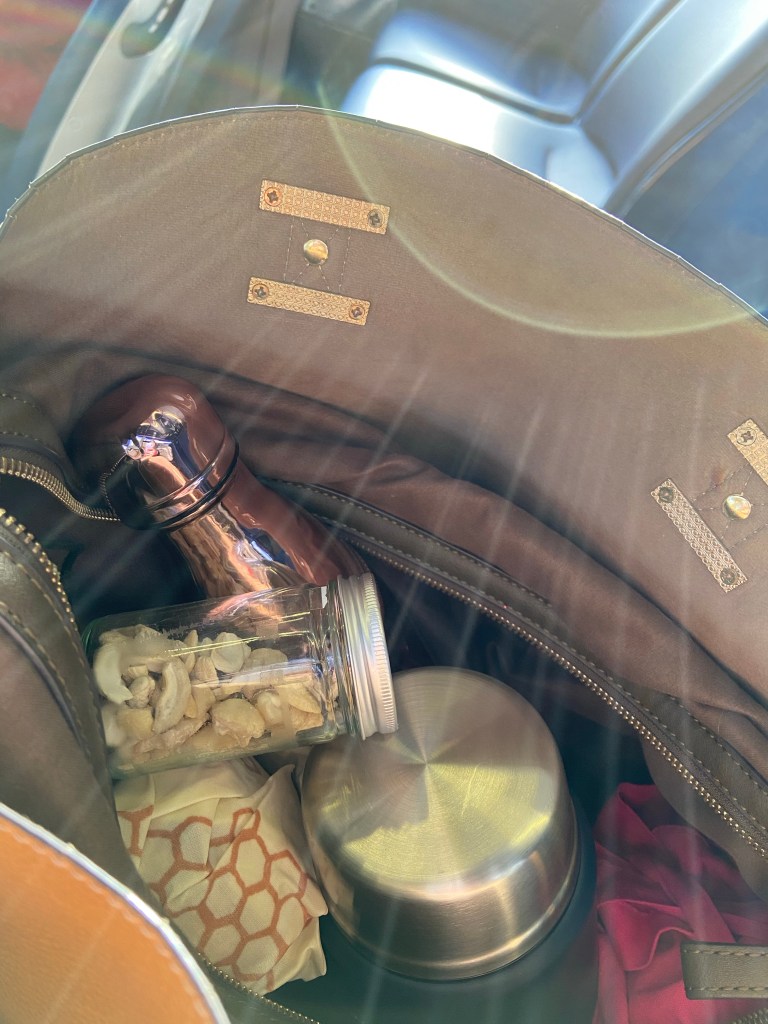
At the moment, my go-to food is soup, because it fills me up and keeps me warm in this cooler weather. What I tend to do is batch make soup on my day off, then use that through the week, occasionally swapping in another meal when I get bored. I heat up my soup before I leave the house and put it in my keep hot container. I also take a bread roll with me, which I’ll buy loose from a supermarket. This I either keep in the paper bag I bought it from, or put in beeswax wrap. Then, I’ll take a little snack (usually nuts) which I’ll put in Tupperware or a small glass hat I have spare. As I’ve said before, I always have my chilly’s bottle, so I fill that with water and take that too.

As with most low waste things, it’s all about thinking ahead and preparing what you can. Hopefully this is a habit I’ll never get tired of!

Design a site like this with WordPress.com
Get started